Annoying 9

I’m just staring at 9^5 and thinking there must be an easier way to think about this.

9^2 = 81
9^4 = (9^2)^2
9^5 = 9^4 × 9 ¿

6561

6561 * 9 yuck
6500 * 9 + 61 * 9 yuck.

9"is 10% less than 10
6561 *10 - 6561 different yuck.

Does someone have an idea on how to mentally avoid the carries?

59049

I split this into 2 parts:
1: 65 - 10%
2: 61 - 10%

1: Add a zero to avoid dealing with decimal points. 650 - 65. To avoid the carry I subtract 70 from 650 to get 580 then add 5: 585
2: Add a zero: 610. subtract 60 first: 550 then subtract 1: 549

Add 58500 and 549 to get 59049.

Thanks I knew there was a way through the mud but I couldn’t see it.

I’d imagine 9^5 as =9^2 x 9^3 = 81 x 729 = 81 x 720 + 81 x 9 =
= 9 x 9 x 8 x 9 x 10 + 729 = 9^3 x 80 + 729 = 7290 x 8 + 729= 7000x8+290x8+729= 56000+2320+729= 59049

or even better 81 x 729 = 81x7 | 81x29= 5 67 | (80x30-80+30-1) =
=5 67|23 49 = 5 90 49

So you just carry/remember 567, and attach its last two digits to the first two digits of 81x29=2349, after you find it.
Note, to mentally find 81x29, it’s important to instantly regognise such multiplication as (80+1) x (30-1).
I used this identity [ (a+1)(b-1) = axb -a +b -1 ] thus by applying it, 81x29 is just converted into basic addition: 2400 +30 -80 - 1= 2349
(7th grade math) . If one knows all such identities by heart, then I think that this method is much faster than cross product (especially if the numbers are not shown, but visualised). But okay. There are many methods to find that.
E.g In some circumstances, I could may instantly notice that
81x29 = 87x27 = 57^2 - 30^2 = 3249 - 900=2349

Nodas

1 Like

:slight_smile:

As always, excellent post. I use these patterns too.

I had to multiply 87 X 31 today.
I changed this into 90 X 30 - 3 which is calculable in an instant.
(because 90 x 30 = 90 x 31 - 90 = 87 X 31 + 3 X 31 - 90 = 87 X 31 + 3)

We call this 7th grade algebra. However; I have never seen this taught in schools :frowning:

Hi Kimna, your example 87x31 required the identity
[ (a-3)(b+1) = axb -3b +a -3 ], which is not instantly as obvious as
[(a+1)(b-1) = axb -a +b -1 ]. (which a simple case of a multiplication ladder, also like (a+1)(b+1) = axb +a +b +1)

So, in that case, if I know the 30x30 table, I should also be familiar to recall most multiples of 31 , such as 8x31=248 or 7x31=217
Thus, I think that for 87x31, I would personally just prefer to add 2480+217.
The trick is to carry/remember the digits 24 80 in short-term memory,
and while I recall 7x31= 2 17, then I attach those to the carry, in order to get 26 97

Or even better just subtract:
87x31=(100-13)x31= 3100 - 13x31 = 3100 - 403 = 2697

If one recalls stuff like 13 x 31=403, then 87x31 is just converted to a simple subtraction 3100 - 403. (since 13 & 87 are complementary to 100)

Again, many methods to choose from. If someone can visualise the cross-products, then that may be more efficient than mine. But it’s purely subjective which the ‘fastest’ method. It depends on the circumstance. For me it may be "recall and convert to subtraction’, for someone else it may be ‘the ladder’, for someone else ‘a visualisation of the cross-products’. This needs some kind of creativity sometimes. It’s not always mechanical.

Nodas

Actually, it is Kinma :slight_smile:

It is indeed not obvious. Let me explain how I work with these kinds of numbers.
If I see 69 X 29, I start with 70 x 30, then I think how to get from 70X30 to 69X29.
Well, I need to subtract 70 to get from 70X30 to 70X29.
Then I need to subtract 29 to get to 69X29.
I thus need to subtract 99 in total.

Alternatively I can to subtract 30 to get from 70X30 to 69X30.
Then I need to subtract 69 to get to 69X29.
Again; I subtract 99 in total.

2100 - 99 is a very easy calculation.
This turns a difficult calculation into an easy one.
Which of course is the whole point in mental calculation.

In the case of 87X31, the plus 90 (going from 90X30 to 90X31) and the minus 90 (going from 90X30 to 87X30) cancel each other out which makes this calculation so easy to do once you realize this.

True. This is what makes it so much fun.

Yes Kinma, your method is also very intuitive and correct.

I also noticed that those cancel each other out
I just wanted to express those numbers (87 and 31) algebraically
as (a-3)(b+1) = axb -3b +a -3 , in order to prove why this happens.

About the 69x29,
besides the ladder (2100-30-70+1)
it’s also 69x29 = (49+20) x ( 49-20) = 49^2 - 20^2 = 2401 - 400 = 2001
I think for people that can recall 49^2=2401, then that subtraction may be simpler.

Finally, via factorization, it can also be 69x29 =3 x 23 x 29 = 3 x 667 =2001
(since 23 x 29 = (26-3)x26+3)=26^2-3^2=676-9=667,
or 23 x 29 = 23 x (30-1) =690 - 23 =667

Nodas

Let’s continue.
59049 is a 5 digit number. However, for a mental calculator it is a 4 digit number.
Any carry from the ‘9x49’ will go into the zero, so this is easy indeed.
This makes 59049 easy to multiply by 9.

590 - 59 = 531 (subtract 60 then add 1)
490 - 49 = 441 (subtract 50 then add 1)

So 59049 X 9 = 531441

Good solution Kinma. The brute force by converting 9 to (10-1) and do the subtraction, always works.

However, again there are many more methods for 9^6.

A. 9^6 as =9^3 x 9^3 = 729^2 = 7^2 | 2x7x29 | 29^2 | =
= 49 | 4 06 | 8 41
Then,merge to get 53 14 41

B. 9^6 as =9^2 x 9^2 x 9^2 = 81 x 81 x 81 = 81^3 =
80^3 + 3x80^2 + 3 x 80 + 1 = 512000 + 19200 + 240 + 1 = 531441

C. If you are bored from math and identities, then instead, you can always memorise the first 100 cubes. E.g : Use PAO or Major for linking 81 and hardcoding it to 531441. 81 can be a P/A/O image, linked to 1 or 2 PAO images for 531441

Takes a bit of work, but afterwards it can be ready knowledge. I don’t know much of mnemonics, but I’m sure it can be possible for most people in this forum, to link the 90 2-digit numbers (10-99) to their respective 90 cubes. Some of them ending in ‘0’ like 10, 20…90… are very easy… while others like 11^3 = 1331 are intuitive
Nodas

Also; the binomial expansion of (10-1)^6 is easy to mentally calculate:

28a6d79ecfecab5040d2b84fbd98f13f.png

Using x=10 and y=-1 we start with 1,000,000 (x^6).
We then subtract 600,000 to get 400,000 (6x^5y).
We then add 150,000 to get 550,000 (15x^4y^2).
We then subtract 20,000 to get 530,000 (20x^3y^3).
We then add 1,500 to get 531,500 (15x^2y^4).
We then subtract 60 to get 531,440 (6xy^5).
Finally we add 1 to get 531,441 (y^6).

All these steps are small and can easily be calculated mentally.

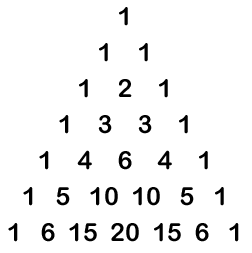
Pascals triangle is easy to calculate, generate or memorize:

Pascals Triangle

It is not the speediest way to get to the answer. However; this is great practice. Start with (10-1)^2, then (10-1)^3, etc. and see how far you get.

Kinma, that was another great solution.

It turned out to be quick, because y=1 so the ‘y’ factor is negligible in multiplication. But for a different y, the binomial expansions get much more complicated.

Also, the x was 10 which has very obvious powers (100, 1000, and so on) ,

However, after the first two-digit powers (^11, ^12,) the coefficients of the Pascal triangle get rather cumbersome .
e.g
for the 11th power it’s 1, 11, 55, 165, 330, 462, 462, 330, 165, 55, 11, 1
for the 12th power it’s 1, 12, 66, 220, 495, 792, 924, 792, 495, 220, 66, 12, 1
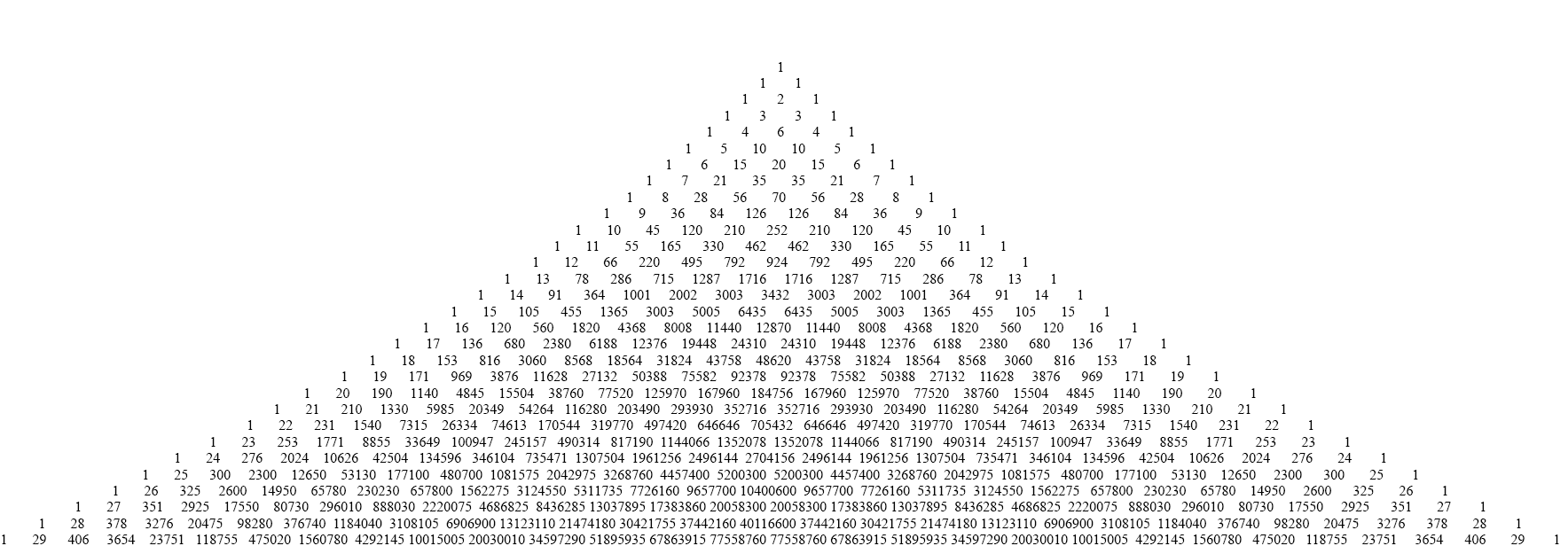
(all the first 30 Pascal triangles/coefficients can be found in this image

As you imagine, such higher coefficients are very difficult to deal with, even single digit numbers like 7.
With the Pascal method it’s just pure brute force of calculating the Binomial expansion. No techniques. To realise how hard it would be to mentally do that, check this example 7^12:

7^12= (10-3)^12= 10^12 - 1210^113 + 6610^103^2 - 22010^93^3+ +49510^83^4 - 79210^73^5 + 92410^63^6 - 79210^53^7 +49510^43^8 - 22010^33^9 + 6610^23^10 - 12103^11 + 3^12
since
(x-y)^12=x^12-12 x^11 y+66 x^10 y^2-220 x^9 y^3+495 x^8 y^4-792 x^7 y^5+924 x^6 y^6-792 x^5 y^7+495 x^4 y^8-220 x^3 y^9+66 x^2 y^10-12 x y^11+y^12

And that was only for a simple example like 7^12. I think it’s almost impossible for a human (without pen/paper/abacus) to mentally do so many operations while carrying so many digits in short term memory. The situation gets even more difficult with 2-digit numbers, like 17^12 or 26^14.

Thus, in my opinion it’s much simpler converting 7^12 = (7^3)^4 = 343^4 = (343^2)^2
The only thing needed then, is to just calculate 2 squares. One easy:
343^2 = 9 | 2 58 | 18 49 = 117649
and then take square of it 117649 = 117^2 | 2117649 | 649^2 =
=13 689 | 151 866 | 421 201 = 13 841 287 201, that’s exacty 7^12,
the easy MC way.
Because 7^12 = (343^2)^2 is a piece of cake to do, compared to that Binomial expansion.

But the easiest way, it is to just memorise it, and when hearing something like 7^12 , to loudly spout the digits 13841287201 as Rudiger Gamm does.

Nodas

I enjoyed the couple of hours spent playing with Pascals triangle. It didn’t help my calculating but it was a trip into all sorts of interesting nooks and crannies of math.

I can imagine that it might be possible to use sequences other than the binomial theorem to calculate. And I can imagine that there are sets of calculations where the knowledge of these sequences might be more mentally calculable than the binomial theorem but imagining is about as far as I get.

I keep thinking that triangular numbers might be helpful but I haven’t found anything in my searching on practical use of them in arithmetic.

This is true. It indeed quickly becomes difficult.
However; I said it is great for training.
At some point you will reach your limits doing 9^2, 9^3, 9^4 this way.
And that is the very point of his. At your limit you will learn best and your digit span will improve the most. IMHO at least :slight_smile:

True. It is.

For fun, try this:

121 - 8^2 = (10-2)^2 = 100 - 2X10X2 + 2X2 = 100 - 40 + 4 = 64

1331 - 8^3 = (10-2)^3 = 1000 - 600 + 120 - 8 = 512

14641 - 8^4 = (10-2)^4 = 1X10000 -4X1000X2 + 6X100X4 - 4X10X8 + 1X16 = 4096

etc.

It is true what Nodas says. This becomes difficult after this.
But hey, we do this for training, concentration, digit span and bragging rights :wink:

I agree again with Kinma. The use of Pascal triangle on Binomial exansion maybe useful for the first couple of powers. (2, 3, 4 and maybe 5). But after that it gets rather cumbersome.

Kinma, your next step after
“14641 - 8^4 = (10-2)^4 = 1X10000 -4X1000X2 + 6X100X4 - 4X10X8 + 1X16 = 4096”
is the fifth power coefficients: 1,5,10,10,5,1.
Since these are easy factors to memorise, I think the 5th power is the last useful power that one can get mental arithmetic benefit from the Binomial expansion.
e.g. 8^5 = (10-2)^5=
= 1X100,000 - 5X10,000X2 + 10X1,000X4 - 10X100X8 + 5X10X16 - 32 =
=100,000 - 100,000 + 40,000 - 8,000 + 800 -32 = 32768
The first 2 parts are the same (100K). So then, the operation
40,000 - 8,000 + 800 - 32 = 32768 is rather easy.

But again,
8^5 = (8^3)x(8^2)= 512 x 64 = (5x64)| (12x64) = 3 20 | 7 68 = 32 768
is maybe easier, because you don’t even need to remember the fifth binomial expansion, 1, 5, 10, 10, 5, 1, and there is no danger in messing up the plus/minus signs in subtraction’s expansion (beware!)

An even easier way is
8^5 = (2^3)^5 = 2^15 = (2^10)x (2^5) = 1024 x 32 = 32 768
That’s simpler , because I’m sure most people in this forum know by heart the tenth and fifth powers of 2 respectively, (2^10 = 1024, 2^5 = 32), since we use it a lot in conversion from Bytes, Kilobytes, Megabytes, Gigabytes, etc.)

Nodas

True. I hardly ever use beyond 5 or 6 or so. The triangle is also easy to generate for the first 5-6 layers.

And, indeed, like Nodas says, sometimes you have to search for an easy way to calculate things.
Converting 8^5 to 1024 X 32 is a great example of this.
Essentially, 1024 X 32 is a 2X2 multiplication (and an addition of 32,000).

2^10 = 1024 and 2^20 = 1,048,576.
These are indeed great numbers to work with.
For example, keeping with the exponents of 8, if we want to calculate 8^8, or at least estimate the answer, we can convert this to 2^(8x3) = 2^24 = 2^20 X 2^4. 2^20 = 1,048,576 and 2^4 =16.
We can easily see that the answer is more than 16 million.
How much more? Well, 1,048,576 is almost 1,050,000, which is 5% more than 1 million.
Add 5% to 16 million to get 16,800,000.
You can calculate this exactly, but in 2 seconds you can guesstimate that the answer is about 16.8 million.

One step further in estimating the answer is to multiply, 16 by 48 (=16X16X3=256X3=768) and round up.
Since 16X1,048 is thus 16,768 the answer is about 16,770,000, which is accurate to 4 digits.

Why am I telling all this? With a bit of knowledge things are easier to calculate or at least estimate.

Hi Kinma, again well said.
I think there is no standard rule. Whatever solution is faster, more efficient and whatever works according to your knowledge, then that should be used.

For me this would be the fastest :
(8^8=8^{222}=((8^2)^2)^2=(64^2)^2=4096^2 )=
(= 16 00| 76 80 | 92 16 = 16 77 72 16)
So, I just raised 8 to its square, 3 consecutive times. I know by heart the first 2 squares (8^2, 64^2) so I’d only calculate (4096^2).

Also, guesstimation is faster and requires only a couple of seconds like Kinma said, if one can instantly see that:
(8^8=2^{24}=2^{20+4}=2^{20}*2^4)
and recalls that :
(2^{20}=1048576)

But again, we’re doing almost the same since:
(8^8=2^{24}=2^{12*2}=(2^{12})^2=(2^{10+2})^2=(2^{10}2^2)^2=)
(=(1024
4)^2=4096^2)

Thus (2^{24}) is a basically reduced to (4096^2), if finding squares is your thing. Otherwise, power iterations of 2, will also get you there, since doubling a number is rather easy.

Nodas

P.S Thanks to Josh for embedding the MathJax notation. Very helpful !

Thanks, Nodas.

Not all readers might immediately understand how we can square (4096) really fast.
Here is the way I do this and I suspect you do it the same way.

Essentially I do:

((4000 +(100-4))^2)

These are all round, simple numbers.
Using binomial expansion:

((a+b)^2 = a^2 +2ab +b^2)

with (a = 4000) and (b =(100-4)) we get:

(4000^2 + 2x4000x(100-4) + 96^2)
((96^2 = (100-4-4) | (4^2) = 9216))
(= 16,000,000 + 800,000 - 32,000 + 9216)
(= 16 00| 76 80 | 92 16 = 16 77 72 16)

Kinma, essentially we use the same method.
But for mental math, I am skipping imagining any algebraic identities containing a, b. (usually). I also skip the 0’s (thousands, millions, billions etc.) The decimal system is already a positional number system, so such tricks are allowed. So, instead I merge the positions. I find that adding so many 0’s is a bit superfluous, that why I always used a positional system since high school, because the traditional multiplication algorithm is not very fast.

For 4-digit numbers

  1. I just split them into two 2-digit parts
  2. take their respective 2-digits quares (requires knowledge/recall of any of the first 100 squares) ,
  3. stick their doubled product, in the middle position, and then merge the two-digit numbers
    e.g. 2048 is 20 and 48
    (2048^2=20^2| 22048 | 48^2 = 400 | 1920 | 2304 )
    You imagine that as 4 00 | 19 20 | 23 04
    and then merge any 2-digit near the vertical split line
    thus 4 00 | 19 20 | 23 04 = 4 19 43 04 = 4 million 194 thousands 304

It’s just 3 easy steps:
Step A: 20 squared = 400, carry it
Step B: Double x 20 x 48 = 2 x 960 =19 20 , then add the ‘19’ hundred part, onto the 400 carry. The new carry is “4 19 20”
Step C: 48 squared = 23 04, then add the ‘23’ part
onto the last block of carry (20), e.g. 23+20=43
so recite 4 19 43 04 = 4 194 304, you can split that to any digit block you want

This always works, and it’s a very fast algorithm for mental calculation.
(well, okay it also requires memory of the 100 squares, but there a lot of symmetries and patterns in the squares, as we discussed earlier. )

Arthur Benjamin also does the same in his shows for 5-digit numbers:
He splits the 5-digit into a 2-digit and 3-digit parts, recalls the squares, places the double product in the middle, merges all the parts and recites, from left to right. This is better for oral mental multiplication and recitals. But for pen/paper mental multiplication the cross-product method may be a bit faster, and also more errorproof and reliable.

Nodas