Eu estou fazendo minha lista Major system 00-99, porém estou com dificuldades em encontrar verbos, pessoas e objetos para alguns números e não achei nenhuma em português na internet. Alguém conhece alguma lista?
2 Likes
Eu achei um site com algumas listas Major sytem em português, algumas palavras são pouco intuitivas e preferi não colocar no minha própria lista, ou seja, continuo com algumas brechas. Caso alguém conheça alguma lista, por favor, me avise.
Links dos sites (o último tem verbos, mas ele não usa o Major system convencional, é necessário fazer uma conversão primeiro):
https://app.memrise.com/course/5773783/sistema-mnenonico-de-numeros-sem-digitacao/
https://app.memrise.com/course/61956/sistema-mnemonico-numerico/
https://app.memrise.com/course/5780170/sistema-pao-pessoa-acao-objeto-de-memorizacao/
1 Like
Which numbers are you having trouble with? (You can write it in Portuguese if you want.)
1 Like
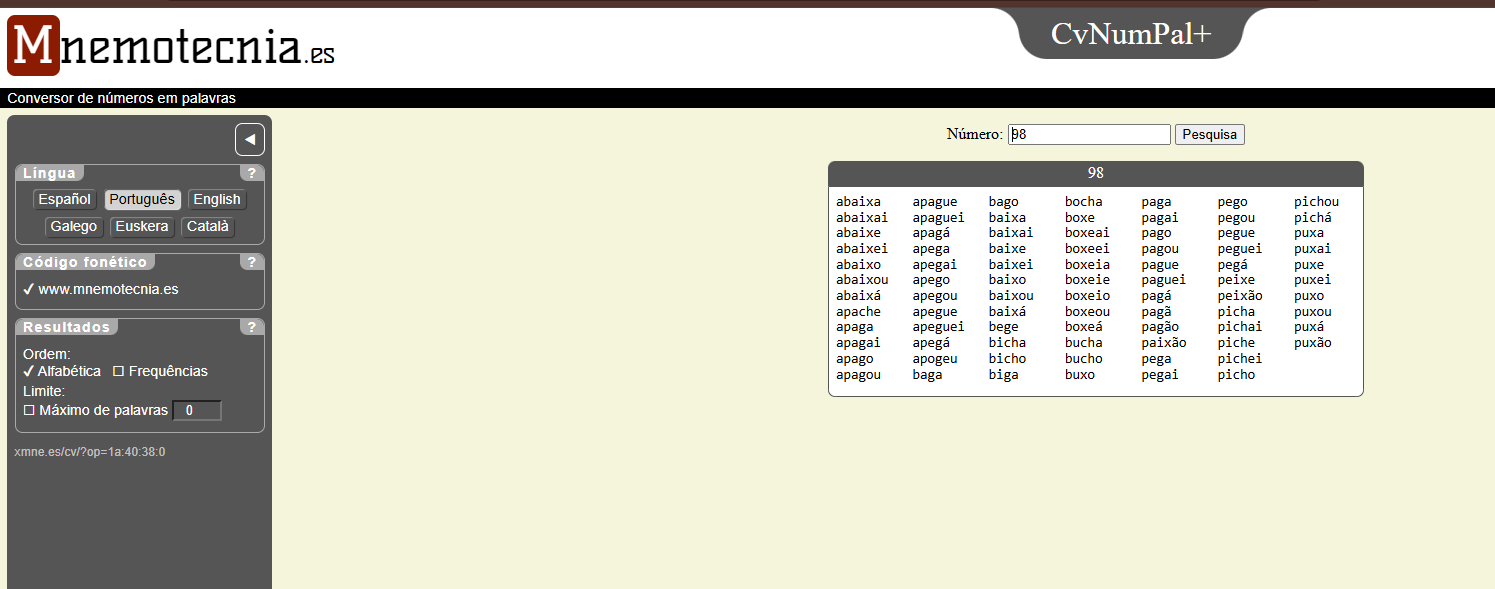
First, thank you for spending time trying to help me. I managed to find a verb/person for each number, but some of them aren’t that good, and I would like to have a wider variety. I’m trying to find out more people/object for: 18, 44, 55, 61, 80, 98. I want to find out some more verbs for the numbers: 18, 23, 27, 54, 44, 47, 66, 89.
1 Like
Have you tried using a dictionary that auto-completes?
There’s one here. If you’re looking for words in Portuguese, set it for Portuguese to English and type the first consonant, followed by a vowel, and then by the second consonant. If you don’t see something that can be turned into an image, then change the vowel. I’d make a list of possible vowel combinations and go through them in order: a, e, i, o, u, ei, ai, ia.
Example:
44 = RR
First type “rar” and look at the suggestions. Then try “rer”, “rir”, “ror” and the others. That produces words like:
- raro
- raridade
- rarefeito
- rir
- teste de Rorschach
They might not produce words that directly refer to an image, but it might be possible to create an object by associating it with a word like “raridades”.
In my system, I couldn’t find exact images for everything so I had to stretch things when I got to the last numbers. One example is my image for 753. It produces the sound “KAIM” which doesn’t sound like any word in English. I turned that into the word “crime” and then linked that to an image of a chalk outline. So 753 means a chalk outline. I have a lot of stretched images like that.
For people you could try looking through this list of 10,000 people. There’s also a way to search for people by initials here.
4 Likes
Thank you very much, Josh! I’m going to do that.
1 Like
Eu estou tentando entender como devo utilizar essa lista. Eu preciso memorizar o que vai me ajudar a memorizar?
1 Like
Sim. Depois de memorizar o sistema, é possível memorizar mais coisas de forma muito mais rápida. Recomendo utilizar o Anki. Há templates para isso:
Obrigado!
Anki is only useful if you’ll use the methods occasionally, but if you’re going to use them regularly, it’s not necessary. You can create the list in Google Sheets or Excel and practice with it.
To learn the list systematically and without overexertion, take 5 days. Divide the sets into 20 and practice with 20 sets each day. Review the previous day’s list and learn the current day’s list, and that’s it. After this, use the list in your daily life, for example, to plan with it. This could be for goals, habits, shopping lists, etc., to make it automatic.
There are two general ways of processing mental information: conscious and unconscious (there are more, but these are the most common). To go from conscious (voluntary attention) to unconscious (habit, instinct), that is, from learning to automatic, you must practice and repeat. So, make your system a habit until using it becomes instinctive and almost involuntary, like speaking or writing.
Something I forgot to mention, so you can automate more quickly and without much delay, is to avoid changing your mental images too much. For example, if you associate the image of a mouse with a certain number, don’t use other images like a cat for the same number, because it will make the process slower and less instinctive, or it will take longer. If you use sets of images for the same number, you’ll have to practice more than if it’s one image per number, as in systems like PAO or others (I use the term PAO because it’s the most well-known here, meaning character, action, and object). Therefore, it’s advisable to use only 10 sets of mnemonic images per day, which gives a total of 10 days of practice. You should learn the system and use it as much as possible throughout the day.
Some advanced systems can be complex for beginners, so it’s best to add them later, once you’ve mastered the initial systems.
There’s also the concept of interleaved practice and deliberate practice, as well as a technique I call adaptation by difficulty level. This involves increasing and decreasing the difficulty, for example, challenging yourself to memorize 20 random numbers in 1 minute. If you find it easy, increase to 40, but if you find it difficult, decrease to 30. What happens here is that by increasing and then decreasing the difficulty, you’ll be faster, even if you weren’t before, because your brain has to adapt. Interleaved practice means not practicing the same thing repeatedly. If you practice memorizing random numbers, switch to dates, stories, and then to card numbers. Even though they’re all numbers, the context of what you’re doing changes, preventing you from getting stuck in the same practice. Another technique is to focus on weak points and improve them with constructive criticism—practical criticism that you can use. Do this in real-life contexts. For example, memorize card numbers, important dates, etc., and find weaknesses; in other words, make associations. Weak or over-elaborate, making the memorization process slower; here you must look for a middle ground between good association and speed.
2 Likes