If you were to teach mnemonics to 5th graders who have never heard of the art of memory what concepts would you teach and how would you approach it?
3 Likes
@RonaldJohnson, I’ve taught an 11th grade student the basics of some mnemonic techniques. And I remember being enchanted by an imaginary story in 9th grade. But what kind of task motivates a 5th grader to want to memorize something? Geography? Entertainment? The Bible?
I was invited to give a lesson on mnemonics at a private Christian school because they would like to incorporate the art of memory in their curriculum from 5th to 12th grade. I usually teach older students but I wasn’t for sure how to approach younger students perhaps I could do the Link Method, Shaper and Rhyme System? They did not tell me anything in particular they are memorizing but instructed me to give a general lesson.
1 Like
I did a great short easy exercise with my Bible study group of older adults (who have attention spans of kids) for the 10 commandments using the body as a palace.
| Column 1 | Column 2 |
|---|---|
| 1 – top of head - You shall have no other gods but me. | 6 – “ouch” - You shall not murder |
| 2 – nose - You shall not make unto you any graven images | 7 – knee caps - You shall not commit adultery |
| 3 – mouth - You shall not take the name of the Lord your God in vain | 8 – foot – You shall not steal |
| 4 – heart - You shall remember the Sabbath and keep it holy | 9 – ball of foot - You shall not bear false witness |
| 5 – loins - Honor your mother and father | 10 – toes - You shall not covet anything that belongs to your neighbor |
I did it in an hour. If you want my story for the items and the hand motions that go along with it, I can write it down for you later. This has the Major system built in if you want to use that later as a second lesson depending on your time or as a demo to show that you can do them out of order when they ask “what’s the 7th? what’s the 3rd?”.
2 Likes
Here’s the hand actions and story to tell for the (Protestant version) Commandments. You can use only the actions as a review with the audience to see if they remember as you call out the numbers. A fun ending to the class.
| # | location | Commandment | action and story |
|---|---|---|---|
| 1 | top of head | You shall have no other gods but me. | (point to sky) God is in heaven above me. |
| 2 | nose | You shall not make unto you any graven images. | (squeeze nose like a sculptor molding clay) No sculptures to worship. |
| 3 | mouth | You shall not take the name of the Lord your God in vain. | (“There is no …” put finger over closed mouth for shhh!) Don’t use your mouth to speak about God like a fool. |
| 4 | heart | You shall remember the Sabbath and keep it holy. | (Hold hands up to pray over heart.) Pray on Sunday. |
| 5 | loins | Honor your mother and father. | (put hands on waist) Dad wears a tool belt, Mom wears an apron. |
| 6 | “ouch” | You shall not murder. | (Slap your behind.) Getting killed hurts. You fall over on your rear end. |
| 7 | kneecaps | You shall not commit adultery. | (turn head slowly to ogle, but return quickly while grabbing knee shocked) My wife kicks me in the knee for checking out other women. |
| 8 | foot | You shall not steal. | (imitate running with two fingers) Running away from the cops after stealing. |
| 9 | ball of foot | You shall not bear false witness. | (“well, I do recall you being bad….” look down while pivoting on ball like you are waffling). Now, don’t lie. |
| 10 | toes | You shall not covet anything that belongs to your neighbor. | (curl your toes to feel shoes, curl fingers also) My toes want those new shoes my neighbor has. |
2 Likes
Thanks, appreciate it. Good stuff
1 Like
Sorry what age are 5th graders?
10 - 11 (says google, In Argentina the same)
1 Like
I would suggest teaching the rhyming system and the number shape system. You could get them to link the two systems together to begin with for example have them associate a bun (rhyme for one) with a candle (shape for one). Let them go through 1 - 10 in that way. An animal alphabet wardrobe from A - Z is another useful peg system to follow up with a further 26 pegs and you can even show them a number-shape system from A - Z where A (looks like a step-ladder from the side) and B (looks like a set of snow Googles) etc. Get them to be creative and come up with their own images and stress there is no one correct answer for each image. eg. 1 could represent a candle, a cigarette, a lighthouse etc.
2 Likes
My daughter is younger, but I’ve had great success with her showing her how to memorize a shopping list using the method of loci, just pointing to different places around the living room. We make up silly images to put in each place and then I point to each place and she remembers what’s there.
The main idea I’d focus on is that (a) you need to make vivid silly images, and (b) placing them in loci is a good way to remember them.
I’d start with the basics of 0-9 of the Major System and then introduce the method of loci. Once they’ve got those two basics down reasonably I’d expand their Major system up to 99 at a minimum.
The tougher part then is expanding your pedagogy to build these tools into the curriculum so that you’re actively using them with your content.
You might appreciate the experience from Lynne Kelly here: Candlebark School and Memory Systems – Lynne Kelly. Her excellent book Memory Craft also has some interesting examples and stories for children including the use of what she calls rapscallions for use in multiplication tables, languages, and other educational applications. Her book also has a wealth of other methods and potential applications depending on the subjects you’re teaching.
I’d love to hear your experiences as you progress with your class.
1 Like
I used a memory palace to teach my kids all 50 US states when they were that age or a bit younger. It’s big enough that they are accomplishing something and small enough that it is doable.
We created a memory palace at the gym we went to at the time and each day we
- reviewed 10 of the structures in the memory palace until they had it down
- learned 1 new state
- reviewed the last 5 states
Then once per week they’d do them all forward and once backwards. I’d sometimes ask them for the states, sometimes ask them for the structures and sometimes ask them for the images so that they wouldn’t default to rote memorization.
My daughter learned it so well that she used it in a talent show where she “read the mind” of her partner who was looking at the screen behind her.
Learning this way (groups of 5 states) enabled her to know what number corresponded to which state so audience members could call out numbers and her partner would “look” at the state corresponding to that number. My daughter would then “read her mind” and name the state.
Hope this helps.
1 Like
For starters, I would tell the students how important it is and how it will help improve their memory.
Interesting subject.
Children don’t readily take to abstractions. I’d try to keep the images as concrete as possible.
Children are not much motivated by being told something is good for them. That argument has already been used too many times to coerce them into doing something they don’t like.
Nor are they much motivated by long range plans. Stick with techniques that can be learned quickly and give immediate results. Journey Method and Linked List would be good candidates, IMO. I would wait on teaching a number encoding system until they have experienced some advantage from mnemonics and are properly onboard.
Every age group has it’s own culture. I’d investigate the movies/cartoons/media they are into and draw on characters and events from that material.
2 Likes
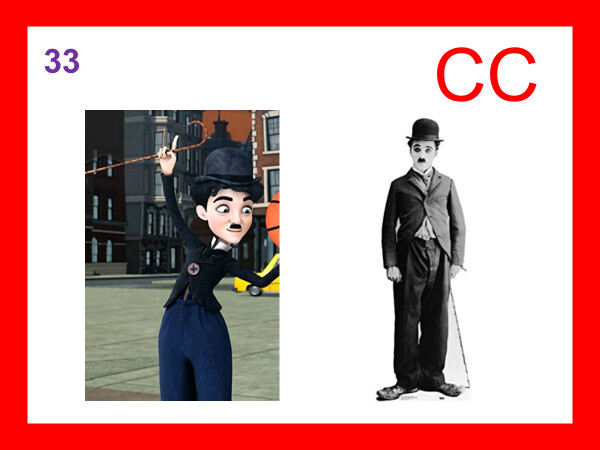
I agree with everything you’ve said. I would get the 5th graders themselves involved in coming up with their own pegs using an encoding system though, more especially if we are referring to a PAO one (e.g. Dominic System). I would find many of my characters wouldn’t sit well with them, more especially those with ‘sexual connotations’ which should be avoided with so young a group at all costs. I also would think although I have no proof to substantiate it, that 5th graders would take far more readily to all their characters to be visualized in cartoon format as opposed to real life characters. I would rather choose the colourful left hand image of Charlie Chaplin as #33, as opposed to the far more drab black and white photo of Charlie Chaplin on the right-hand side!
1 Like