A few weeks ago I watched this TEDx talk about Dr. Aaron Ralby’s work with memory palaces and language learning.
I was initially under the impression that his courses were only for learning lanuages, which in itself is fascinating because I’ve not seen anyone else apply the Method of Loci to language learning to such an extent. But I recently enrolled in his video course on memory techniques, and it is very helpful!
One thing that I’ve already started using with good success is the quincunx pattern (like the number 5 on dice):
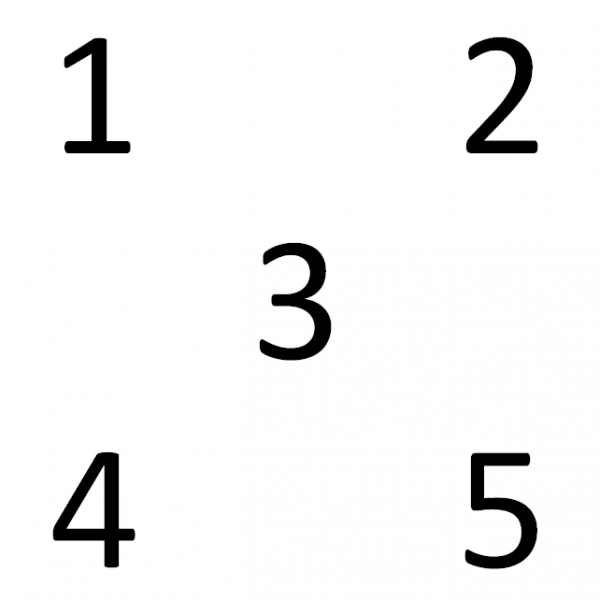
I previously had been using a 3x3 grid of loci as used by Gregor von Feinaigle, but the quincunx pattern solves several problems: By design it forces space between loci, so I’m far less likely to confuse two pieces of information. It’s faster, because you’re only doing 5 per zone, or wall of a room, or whatever, instead of 9 or more. And you can still ‘read’ the loci left-to-right, top-to-bottom like a book but without interference of other loci getting in the way.
As I understand, the ‘macunx’ part is an invention of Dr. Ralby that puts quincunxes within quincunxes within 4 quadrants to give the user 100 loci called a macunx (‘magical quincunx’). This pattern can be used wherever another 100 loci are needed. I haven’t used the macunx yet to speak of its efficacy, but it looks very intriguing.