Imagine, if you can, that when you walk into a house, you sit down, walk around, go to the bathroom, whatever; after a little while, you have absolutely no idea where the front door is. Or the bathroom, even though you already used it. Whenever you go for a walk somewhere, there’s a 50/50 you’ll get lost.
Also imagine, that you have no problem memorizing ᴨ to a 1000 places, remembering the name and face of everyone you’ve ever met, and can easily devour and regurgitate most textbooks. If you’ve got this far, you’re imagining me. I love memory techniques, have been using them for years.
But, the thing that I don’t seem to be able to do, is the method of loci. Or memory palaces. I love the idea of it, but I get lost all the time. Seriously. So, if anyone (anyone at all) has a similar issue, or simply methods to overcome this, I would be immensely grateful.
Just a thought to take the pressure off: nobody says that your memory palaces have to reflect reality or be “correct”.
Either you take a place you know really well.
Or you take a place you don’t know well enough, then just choose what feels the most logical. As long as you’re consistent (the rooms stay where you imagine them to be and you don’t change everything everytime), it’s perfectly fine.
My memory palaces are based on real places, but often turn out to be quite modified in the process of using them.
When I go back to the places for real, I often notice how different it actually is, and sometimes how my mind distorted the space (like the stations are much more closer or spaced apart for real, or they aren’t ordered in a way that makes the most sense physically).
It’s a nice feeling to see the place, I recognise the places and I know which things I stored there, but I don’t see things really “popping out” of the locations because the map of the memory palace in my head is something separate that took a life of its own.
And also, your sense of orientation is like any other skill, some people are at a disadvantage and some people are gifted, but whatever level you start with you can become better with practice.
If you treat it as an experiment the process can even be fun. Try something, and be happy when you failed because it gives you data: what was the point where it failed? why didn’t it work? How can I change the process to help myself pay attention better? Then do it again and again.
Neither beat yourself up, nor find yourself excuses, just stay curious: “and what if I did this? What results would it give? Let’s try! Still didn’t work? Maybe I need to give it a break and try something different in the mean time (like another type of memory palace)…” etc. The more you brainstorm ideas of things you can try, the better you become at being creative and finding them.
If other memorisation techniques came to you easily maybe you’re just surprised at the amount of work it needs. Yes the memory palace is powerful and the basic principle is easy to grasp, but never mind what people tell you it’s not easy (at least for me it wasn’t at all, I took about three years trying it on and off before I really started using it). The reasons are numerous: when I tried it the first time I just wasn’t ready for it… And sometimes I tried to use it in situations where it wasn’t the right tool… And I made things much more complicated that there really are because I thought it should be a crystal clear visualisation of places (which isn’t necessary)… And I didn’t realise that any arrangement in space is a memory palace… And I thought my brain just wasn’t wired the way necessary to use artificial memory palaces… Lots and lots of trial et errors along the way.
Well thought out reply, thank you.
Interesting initial point. Actually, the only palaces I’ve had any success with so far have been entirely artificial. Drawing up a house in software and using that. It actually has worked okay. However, I was often thinking that a lot people do seem to be far better oriented to the world around them than myself, so you make a nice point there about it being a skill.
As you have taken the time to reply, any ideas on how I might actually build this skill?
What I have tried to so far:
a)Memorizing all the street names I past by linking them.
b) Drawing a map of the house/mall/town that I am once I get home.
c) Assigning actions to the cardinal directions [like West is “Wash” and East is “Eat”] and combining elements around me interacting in those directions.
My data so far: “Hmm, I’m not sure why I don’t remember these things…” Well, maybe not quite. Probably I need much more rigor in my note taking. I mean, I can tell you all the street names I’ve linked together, and even draw a map of where I was, however, trying to figure out where I am in relation to something else on that map, or those streets, and I’m pretty quickly lost again. So, if you have any creative ideas of how I might develop this skill, I’m all ears.
Great attitude points though, thanks very much. Keep curious, keep it fun. Good stuff.  Thanks again for taking the time.
Some quick toughts:
- Memorizing street names you pass: my first thought was that it would be more a peg list than a memory palace, if you don’t have a sense of where they are in relation to each other. Not that it’s useless, but depending on how you visualise/conceptualise the results it may not be spatial memory (or at least not majorly) (?)
- Drawing a map: yes, it helps me a lot! If I have a memory palace of a place I can’t go back to (easily), I also use google maps (satellite view, not street view) a lot to help me have clarity about the locations/loci I chose (since path integration is a weak point for me). But I always draw it like the “St-Exupery landing” map: I don’t try to reproduce everything exactly, just what I need or find important or interesting.
- Actions assigned to cardinal directions: I have never tought of that. I guess I didn’t come to the idea because I’m the kind of person who doesn’t remember if I should go left or right to go back where I came from when I go out from a shop for example. Orientating myself with the cardinal points is my weakest point, so it’s not one I rely on.
- Need more rigor in notetaking? Maybe… I think navigating more consciously, with a goal in mind (not in the sense of “where do I want to go”, but in the sense of “what am I trying to do/get better at here”) helps me more than taking notes (both for memory palace building and for sense of direction in general). Not that I don’t take notes, but I feel the bigger part of the work is done before.
For memory palaces it helps me a lot to take my time on site, with a precise goal in mind, instead of telling myself “I’m just snapping lots of pictures and I am going to sort it out at home”. Ideally I have the data to memorise already summerized and organized (so that I know: I need a first zone with 3 locations to store this this and this, then 4 locations, then only 1, etc. Or otherwise said, it’s MUCH easier to build a memory palace when you know what you want to put in it. Building an empty memory palace is a waste of time for me (except if I want to be systematic, with a journey inside it, because the data absolutely need to stay sequential, which you would need for memory competitions for example).
Also I have a 99 PAO (or rather PAL), and I’m more than halfway through building a 999 PAO, because it’s extremely useful for many things, one of it is using it in some of my memory palaces to keep stations in order. On my own, I’m not able to tell the order of the shops on a street: I would remember the corners (first and last shops), but mix everything in between. But if Leia is buying meat at the butcher cutting it with a lightsaber, Noah Bennet buying medicine for his headaches and Mei choosing pumpkins for Halloween, I know that it’s butcher, then pharmacy, then grocery, etc. I suppose it’s “cheating”, but I’ll do whatever works for my poor orientation challenged brain. That way I can leverage the things that, for me, are extremely powerful for memorisation (which are the atmosphere and stories attached to places).
If we are talking about training my sense of orientation in general, I did a lot for it, when I realised I was REALLY bad at it. But it was years ago, before I took systematic notes, so I would need a bit of time to sort things, write things down and organize it. It’s a really interesting subject and I’ll make notes anyway for myself. If you’re interested I’ll post it here (well not everything, but a summary perhaps).
Some really tips there! I especially like the simple, yet effective method of using your PAO for various shops. That I will certainly institute.
I personally have a 999 PAOP system. Person, Action, Object and Postcard. The final part simply being an image of a place. Useful for memorizing long strings of digits, 12 per image. So, although I whole-heartily think everyone should make their own PAO, happy to share any of it if you want.
But back to your point. I imagine simply taking enough time on site to think, “Hey, the jeweler is on 32 Queen st, I can imagine the Queen mining jewels there” could well assist with my orientation goals.
So far I’ve mostly been making empty palaces, with a definite order, and than testing them with numbers or lists of words (or whatever really). The idea of having the data that I’m going to store first before building is a cool idea. I like that.
Again, thank you very much for taking the time to both think about and make suggestions. Really appreciate it. 
Sorry about the late answer… I had the intention of thinking about this and writing during Easter break but… Why I still have the delusion that I will have the time/inclination to be on screens during holidays, I do not know…
Thanks, I appreciate it! You’re very welcome to share your ideas for the numbers I miss (I post from time to time in a thread to ask for help, I’ll be glad of your contributions).
I’m not sure how much of it will help, but here are the notes about the things I did to develop the skill:
First of all, what does it mean to have a good sense of direction?
To have a good sense of direction, you need two components: 1. path integration (even after taking turns, knowing which direction you are facing and where you are compared to your starting point) and 2. recognizing landmarks.
Now the thing I’m really bad at is path integration: I find it difficult to tell which direction I’m facing (like when I come out of a train station, shopping mall, etc.) and I’m really bad at estimating distances (I have the same problem with time, not good at estimating how much time passes).
But still, I get even more lost in malls where there’s no windows to the outside, so my brain must process things like sunlight at least a little bit, so we’re not starting with nothing here.
I’m much better at the landmark thing (or at least I found it easier to progress in that area).
I feel like I’m pretty decent at visualizing maps/plans (maybe because I like to draw), it’s the “knowing where I am” on my mental map that I have trouble with.
It’s worth it to think about :
- what are your strengths (that you are going to use) and weaknesses (that you’ll need to compensate for)
- what are your goals
- you’re not going to proceed the same, and take the same risks, if you’re in a town where some part are dangerous to get lost in, if you’re in a hurry, if you’re on a hike and HAVE to catch that last bus to get back home, etc.)
- in which situations is your bad sense of direction the most problematic : it may be worthwhile to think about these situations in priority
- but also, is there some easier parts of the skill you could make quick progress in, to give you an “easy win” and be encouraged
How to train your sense of direction
Learn to estimate distances
Choose journeys that you know really well (that you walk/drive along every day) and use them as a reference.
For example:
- From my home to the bus stop is 500 meters.
- From my home to the next Aldi supermarket is 1 km.
Walk (or drive) again and again, paying attention to your steps, to how it feels, how much time it takes you.
Then choose a journey that you don’t know well, and imagine putting “in it” the journey you know well. For example, walk from your home to the train station instead of taking the bus. How many times did your “reference journey” fit in it? If it felt like going twice to the bus stop, then it’s 1 km, if it felt like going to Aldi but a bit more, then it’s maybe 1.2 km…
Afterwards, check your answer in the app of your choice.
Repeat the exercise with several unknown journeys to get a better feel of distances.
If you go hiking: it’s useful to know how much height difference you can do easily.
The principle is the same: If I go to the city center going down by the river to cross on the pedestrian bridge and going up again on the other side, it’s about 70 m down and then up. If I go up that hill, from the parking lot to the viewpoint, it’s a 300 m climb.
Does it feel easy? Take a map and find other journeys with diverse height differences to see what’s comfortable for you to climb.
When you hike, take the time after a climb to check the height difference and think about how you felt (take into account how steep it was, how hot the weather was, if it was wet and slippery or an easy road, etc.).
Learn the landmarks
In a town: study the map (I find it easier on a paper map), and identify the most useful things:
- the landmarks you’ll be able to see from afar (hills, rivers/sea, towers, church spires, big parks, etc.)
- the lines that you’ll cross if you walk long enough (big streets, public transport lines, train lines, big high tension eletric lines, etc.)
- the places you’ll need/want to go to: train station, hospital, shopping malls, friends’ places, etc.
Learn how they relate to each other to have a mental map of the parts of town you need.
For example, when I arrived in the town I live in, I memorized the public transport lines (you need only both extremities and the most important stops in the middle). These lines are my “lines to cross”: whenever I get lost, I just need to walk and I will always sooner or later cross a public transport line and know more or less where I am.
For hiking: plan a route in advance (or several routes if you want options) and learn to read a (detailed) map! You should know the difference between landmarks like: rivers (where are the bridges), power lines, tree lines, forest zones vs fields vs wetlands, scree vs cliffs vs ravines, water towers, water treatment plants, etc. Are also landmarks the crossings with established hiking trails (which ideally will have signs/numbers/colors - biking trail, snowshoe trails, ski trails, mountain trails, alpine trails, etc.).
Then during the hike pay attention to keep track of where you are. Don’t wait to be lost to look at the map, check it regularly!
Play games
Get lost game
Go to a part of town you don’t know well and walk aimlessly, just enjoying the scenary, until you get lost. Then find your way back home again.
While you’re walking back, pay attention to the landmarks you are able to use, the landmarks you thought you would use but can’t, etc. For example, if you’re in a sea side town, maybe you expected to be able to use the direction of the slope all the time, but if there are a lot of steep hills it may not be so simple.
You can take a map with you, but try not to use it!
You’re allowed to talk to people. Not only to ask them not only for directions, but for recommandations of cozy restaurants, favorite shops and nice parks. (And if you’re on holiday in a foreign-speaking country, you even get the bonus of free language practice!)
Have fun! Getting lost doesn’t have to be bad. Learning to overcome navigation anxiety helps to become better at it.
Back in the comfort of your home/hotel think back on it: What helped you? What didn’t work? What should you improve and how are you going to improve it next time? What are the cool places you discovered? Which experiences did you make that you would have missed out on if you didn’t get lost?
Then go get lost in another part of town!
Get lost in the wild
I don’t deliberately try to get lost while hiking, because - while it probably wouldn’t kill me to have to spend a night outside without having planned to, it certainly would be very uncomfortable and I’d rather not take the risk.
But you can still play the game differently. At regular intervals, look at the map and say where you think you are. Then switch on the navigation feature briefly to check if you’re right. Then switch it off again until next time. (I’m presuming you have a map on your phone, like almost everybody nowadays).
If you feel unsure, try to find people who have experience navigating without GPS and ask them to teach you. If you don’t know anybody, join a orienteering club, take a course, etc.
Other games that necessitate you to walk around a lot
Playing a lot of pokemon go for a few months did help me getting familiar with even the small twisting streets of my town. Because you are out and about and explore a lot, to catch pokemons and turn pokestops, which often are at landmarks/points of interests - some of which are not really well known).
Of course it takes a lot of time and you have to like it – I wouldn’t have done it if my niece didn’t ask me to play it with her, helping with my sense of orientation was just a nice side effect.
But maybe you can find an activity that will make you walk around a lot in the places that you want to feel confortable in.
Other random things that may help
Paying attention (knowing when)
The truth is: part of the problem is my fault because I don’t pay enough attention. But I can choose to pay more attention, the key is to be self-aware and to identify the moments where I NEED to.
Examples:
- Yes, it may feel ridiculous to take mental notes for basic things that other people seem to do naturally, but you do what you gotta do. For exemples, going into a shop telling yourself “when I go out of this shop I’ll have to turn right when I leave, because I want to go to this other place afterwards” or when invited at someone’s place for the first time “going to the bathroom from the living room: pass the stairs, second door on the right” (visualise a floor plan). Verbalizing (in your head) helps.
- Yes, it feels a waste of time to look out of the window during a bus ride instead of reading (or reviewing anki cards), but I can at least do it for the first few times on a certain journey (and then read once I know the journey well).
- Yes, when hiking, it’s annoying to have to interrupt my conversation with other people to check the map at regular intervals, but if I don’t it’s guaranteed that I’ll miss the fork in the path or the bridge, and we’ll go the wrong way - and have to go back or take a loooong detour because we’re now the wrong side of the river/ravine.
Navigation with “north up”
Sometimes it is better for me to use the navigation feature: when I’m driving (my brain can only concentrate on so much things at a time, so better concentrate on the traffic, since I don’t own a car and am only an occasional driver).
BUT if I have to use the navigation feature, it still helps me a lot to use “fixed north” (north always up): if the map is constantly turning every which way, I really have no idea in which direction I’m going.
Follow the crowd
Especially at the beginning and the end of working hours, the biggest stream of people is going to/coming from the train stations / bus stops.
Follow the sun
Some people swear by it, but I never really managed to tell time while looking at the sun (not precisely enough to be useful anyway). Same for orientation: because I like photography, I know for the landmarks of my town, if they look best by sunset or sunrise (so seeing the landmark X, which direction I’m approximately facing in the morning/evening), but that’s not really the most useful for orientation in practice.
But who knows maybe it would work for you, every body is different after all.
Streets (walking/active) vs Roads (driving/passive)
On a street, you go to live, spend time, socialize… By taking the time to talk with people in streets and parks, you add context and emotions, and you’ll remember the places better. In contrast, roads only serve to bring you from point A to point B. It’s utilitarian and without much human contact.
It may be a personal thing, but for me I know I’m going to remember much more easily the places I’ve had interactions in. That’s why I added the “talk to people” point in the “get lost” game.
You might want to read Dark and Magical Places: The Neuroscience of Navigation by Christopher Kemp.
He’s a science writer with no sense of direction and the book is great when it comes to describing the role of place cells in the brain, etc.
Thank you for asking the question Rupert as I’m in a similar situation.
Very encouraging!
This is fantastic! I can’t believe how much work you have put into this, (by this I mean the reply). Thank you so much. Some really great tips in there. Some of it over the last couple of months has really just been putting the work in. Decision to “fix” (let’s say improve) a lacking skill instead of accepting it. But of course having some direction that that work should flow with is essential, and you have more than provided a skeleton for me to add some flesh to.
So again, thank you for writing this up. Very much appreciated.
Indeed I do want to read this, you are right.  Plus it led me to a few other works with similar(ish) titles that could also help me get a grasp on what might be going on upstairs. Thanks Anthony.
Draw a floorplan, or find one. Some large places I’ve worked provide maps. That said, it’s a good idea to keep a memory journal with you anyway.
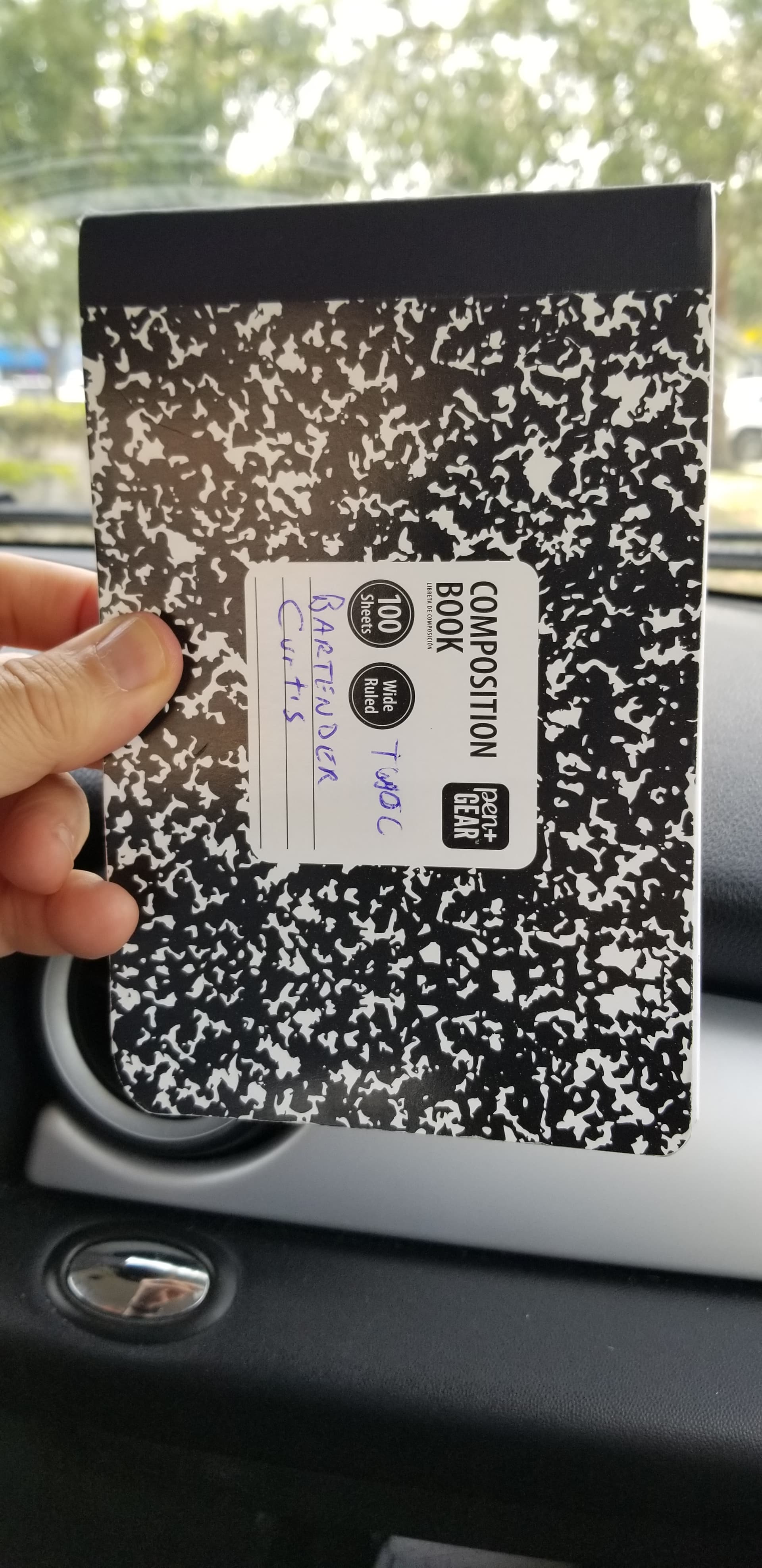
You can also take photos and draw up a floorplan from images later.
Just in case I wasn’t sure what a sketch book looked like.
Floorplan is an excellent idea. I’ve been working on that the last few weeks. Amazing how many details the mind takes in, but would otherwise be lost to time if we weren’t making the effort to recall it. Which, to be honest, I’m finding with little experiment, seems to be at the root cause of all of it. I just haven’t (over many years) been working on developing the ability. Led to some great personal insights.
Great tip, thanks for that.
It may not help directly, but the YouTube channel of Artem Kirsanov does a great job at explaining how our brain works/memorises, including a few videos about what happens in the brain when you use your sense of orientation (virtual maps, place cells, etc.)