It came up in another topic, but I have some trouble creating an artificial memory palace with 10 loci per room. Does anyone have some tips?
Like when putting loci in a bathroom, I get something like: shower, bath, sink, mirror, medicine cabinet, towel rack, toilet, basket for the laundry. That is only 8 loci, and they are really not far apart.
Shrinking myself down is a nice idea, I might get a few more loci out of small things that way. If that doesn’t work I can up the size of the rooms. Thank you Bateman (I started to miss you already :p)
Hello. I always use 5 loci in each room, because it is difficult to me to handle more.
But I do what I call zoom-in, I turn every loci into a room itself. I need to plan this in advance before starting the memorization. So, I need to organize the information hyerarchically.
For instance, if I use a bedroom, the loci are: closet, bed, desk, window, book shelves. Then I turn the bed into a room and I assign five loci: pillow, top of the bed, bottom of the bed, front and back. The closet: upper drawers, lower drawers, shoe area, hangers and upper room for luggage.
What do you do if you have 5 loci in a room and later discover other objects or sites that can be used as loci. Initially they were not included as they did not seem distinctive enough. However later i want to include them. Can i always just add points to my initial memory palace?
I myself have noticed no problems with that,but I have to walk through the memory palace again for a few times, so it isn’t usable the very second I add loci.
Over time I also learned that things often aren’t distinctive because I don’t make them memorable. The advice Bateman gave me in this same topic to make myself smaller as I walk through the memory palace helped a lot, I’ve also started to make things just bigger or more notable. A crack in a single tile becomes a big crack in the whole wall. Things often are as memorable as you dare to make them.
one technique that works well for me is to think of some of the objects as having a cavity or hidden compartment inside, and when I open them, there is something unexpected. If you google weird mailboxes, you’ll get a better idea of what I mean. toilets are easy to do this with. so, however, is a bar of soap. it makes the otherwise mundane objects in the room more interesting as well.
For imaginary rooms, I use the walls and corners, but I let each image act with each other. If I have water there, it might flood the room. Sometimes it’s a good idea depending on what I’m doing, and sometimes it’s not. But, I seem to recall things better if they are interacting.
Lol I concur. Can’t get those images out of my head in the game Alice Mcgee. The more crazy and f***ed up the images along with the atomosphere of my palace the better I remember. Yes cracks in the floor!!!
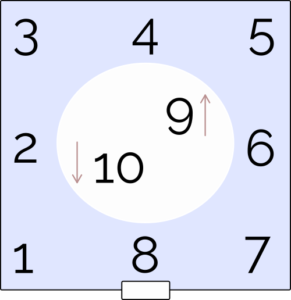
I saw this thread while skimming through old posts. This is the general pattern I use for 10 locations in a room at the moment. 9 is the ceiling and 10 is the floor. When starting, I picture myself standing at the door (position 8) and moving clockwise.
I am SOOO going to do this. I need the stability. I have buildings that I’ve only seen from the outside. I can put action on the walls and corners of the outside of a building based on the land around it (street, parking lot, tree, etc.). I can add an icon (like a sign) on the roof and build an appropriate fake basement for each.
Also, over in the Bible thread (I think it was) someone wrote about going around individual objects clockwise as well. I could expand any item within a room by adding action or things at the 12:00 / 3:00 / 6:00 / 9:00 position - location.
Forgive me if I’m stating the obvious - I’m a beginner stumbling around looking for a way to organize. Art of memory is a great site with great ideas. I’m so glad to be finally getting serious about my mnemonics.
 (I started to miss you already :p)