I’m learning Russian too.
What I do is simple: have a list from “https://de.openrussian.org”.
Then I pick 150 words, copy and insert them in the app “Quizlet”. Then I have a fine looking list of words and a card box at the same time.
Then I go through my palace and combine: 1. the place + 2. the meaning + 3. the word.
Step 3 can be the most difficult one, depends on your creativity and your knowledge. What I would suggest: go for the easy words at first and come back for the difficult ones later. Go through the palace like 10 times within a certain timespan and after a relatively short time you know the words by heart and can use the palace for new words.
You will recognize that long russian words have oftentimes other ones in them. Then you recognize the short words in the word and you will have a better time learning the language
Aymerico
Russian …well known performer named zviz holding a bottle of champagne with a large size DA brand name displayed, wearing revealing clothing with a star backdrop because she is a star. Champagne bottle to introduce fizz sound to counteract my initial tendency to think of her as zviv and I needed to have something carry the da sound anyway. zvizda…She is standing full scale on the door knob of my front door. She is looking mildly surprised at the hinge of the door where there is a very striking image of an eagle with pulsing, brightly glowing, blue eyes. Zvizda is looking at a small star on the eagle’s knee. see knee. The eagle is looking down at the hinge below which has has an o shaped cloud on a dark night with a microsoft start button orb attached to a black lock image in the middle of it. orb black lock shaped like an o.
zvizda = звезда = star, …see knee = синиий = blue, orb lock o = облако = cloud
German…on the east wall of the elevator cab in my building…courtroom with astonished court officials looking at horse in witness box swearing an oath to tell the truth about the bottle of well known German Währe brand mustard he is pointing at. Horse because I use horse as a tag image for neuter words. das Wahre = the truth (not truth but the truth) I drop the umlaut because in the scene playing on the elevator wall, my tag image for an umlaut is deliberately not present even though I know the actual brand name carries the umlaut.
That is one way I use the method.
Another approach that I use to deal with gender issues is associating a tag image with the word. I don’t bother with locations but just build a system of gender tag images into the my mental image of the word.
My tag image of feminine in German is a deer. So my image of street/Straße is a street with a bunch of deer running loose. deer = die = die Staße. I don’t need a location because I have no problem with the word but just need to remember its gender.
Google images is your friend. It will provide images for any sound you can imagine. Break a word down to component parts, type the sounds into google images and you will get thousands of images right away no matter what you type in. Never heard of zviz nor do I know anything about her now. But I know what she looks like, she appears to be a star and her image definitely caught my eye in a memorable way. Put her standing on the doorknob looking at me and now star/звизда is nicely tucked into my memory and also a location to help me in case I forget the last part of the word.
Hello Everyone
I have read the whole text and comments but still… I couldnt dream and understand that how I will memorise the words one after another… I understand that I will orginize the words alphabeticaly and I need to practice them as much as I need. Would any of you please try to make an example from the words I post here? Thanks in advance… (there are totally 20 words) I think remembering -let’s say 4000- words is one case and remembering -4000- the meaning of the words is another case. We can attach them if we are good at it or we can memorize seperatly and after some time we can reorginize our work according to our success or desire. Anyway, I do not want to confuse your minds. Here are the words:
ab from (a~)
ab und zu every now and then (ab ~)
abbauen to reduce, dismantle
abbilden to depict, portray (ab~)
abbrechen to break off, stop
abdecken to cover (ab~)
abends in the evening
aber but
abgeben to give, hand in, submit (ab~)
abgesehen von apart from (ab~)
abgrenzen to enclose, differentiate, distinguish (ab~)
abhalten to keep from (ab~)
abhängen to depend (ab~)
abhängig dependent (ab~)
abheben to lift off, withdraw
abholen to get, fetch, pick up
ablaufen to run out, expire (ab~)
ablegen to take off, put aside, file (abl~)
ablehnen to refuse, reject, turn down (ab~)
ableiten to derive, deduce
ablenken to distract, deflect
Have a wonderful day 
Hi TimothyMoser,
A quick pointer to these hacks and mnemonics for learning sentence structure and grammar?
Kind regards and thanks
metinyucel: it’s been many months since your post, but I’m new here, and I think I’ve figured it out. However, note that I don’t have experience using it - I’m just starting to encode my target language’s dictionary. Also, note that I don’t speak German at all, so I could have made some huge errors. Below, ignore the “blah” fillers.
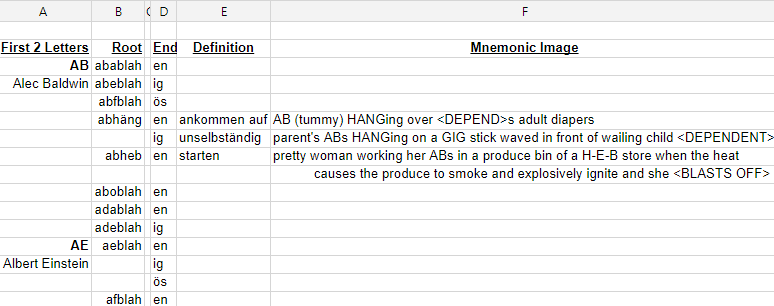
I suggest first going through an initial letter, like “A”, and writing all the words and definitions (preferably in your target language). Note how I’ve separated the endings. If there is an ending without the listed root, then look above for the root. For example, I don’t explicitly write abhängig.
Next, decide how to group the first letters to break up the words fairly evenly and not too many together. Above, we have AB, AC, and AD in one bin, and then AE and AF in the next. (I suspect German has too many AB’s for this, but it works for the language I’m learning.) Then you know many locations your memory palace must have (number of “bins”), and how detailed each location must be (number of words per “bin”). So pick your palace accordingly, e.g., maybe a large grocery store that you know well, if this going to be a big palace with many images at each location. Now pick people whose initials match the first two letters. (This was not mentioned in this thread. A similar idea was put forth in the Magnetic Memory sales pitch, which is probably what made me think of it. But disregard if you want to stick to the original poster’s plan.) Station each person sequentially, each with their own location in the palace. Now create your images, and you can start having the person interact with each image in sequence in his location.
For example, we might use a particular grocery store for the palace, and we might imagine Alec Baldwin holding his nose as he looks in humor and disgust at a fat woman whose ABs are overHANGIN’ her {DEPEND}s adult diapers, which is all she is wearing, as she starts eating a carrot from the first location of a grocery store, the produce section. The definition is in brackets (<> or {}). So we’ve learned that abhängen means “(to) depend”. Then we imagine Alec Baldwin disemboweling a man, sticking his ABs using a GIG stick (used to impale frogs) and laughing while waving the guts in front of the man’s wailing child {DEPENDENT} whose tears cause a “clean up on aisle 1” call and a worker instantly arrives to mop up the tears (and guts). Then Alec moves on to coach a pretty woman doing sit-ups to work her ABs in a produce bin that has the letters “H-E-B” (a grocery store chain in Texas), with Alec coaching her to go faster and faster until the heat causes smoke and the produce explodes so she {BLASTS OFF}.
Note: The traditional way is for the definition to be the direct object of the action in the image. I didn’t do that in a very clear manner. And anyway, that wouldn’t work well for verbs.
Location 2 in the store might be the bread section and might be hosted by Albert Einstein, who handles the AE and AF words. And so on. Then you use a different store or cafe or something for the B’s. And on and on.
The result will be that you can read in the language, slowly, without resorting to a dictionary, because the dictionary is in your head. For speaking and writing, I’m wondering if a reverse dictionary will be necessary as well, e.g., going from “(to) depend” to abhängen. Or will you be able to random access the “depend” image without that?
Side note: Following the advice in this thread, I asked around for a simple monolingual dictionary in my target language (again, not German). I was informed by multiple locals (including a bookstore worker) that there are no normal dictionaries at all for this language. They only have dictionaries to translate to and from other languages. LOL. They said everybody knows all the words. LOL. By my count of a translation dictionary, there are only about 7,500 words in the whole language, so I figure I might as well learn them all. (Also, about half of the words are borrowed from languages I know, so one glance at them is all I need.) But at least I found a translation dictionary that does a good job of grouping words by roots, putting all the words from the same root in the same entry.
I’m a new entry, so I would like to know how you memorize the vocabulary.
I understood how you separate them etc… but how do you memorize the words?
I mean, you put in in your loci etc and then? you link them with images, story, sound alike etc…?
How you memorize words ? Linking connection between sounds and meaning ? How ?
Bom dia PauloPalma,
I commend your contribution to the forum and hope one day to be able to give back to the community myself.
I realise that this is an old post, but concerning your method, if you require a willing subject to test your method in real time, please consider me.
My wife and I own a property in Austria but our attempts at learning to speak German have been futile; neither of us has committed ourselves because we have allowed ourselves to become easily distracted.
For a variety of reasons, personal and professional, we have decided that 2019 will be a year of change. Personally, I want to achieve B2-C1 fluency by 2020.
Please consider my offer/request; perhaps we can record my progress (in written and video form) and make it available to the forum?
Adieus,
Nige
It has been a lifetime since I studied German, but I remember how I filled my head with enough of the language to visit Germany a few days in 1982. For me the most difficult part was knowing that I don’t know the language well and my fear of sounding uneducated in front of a stranger. I had one year of German in school, but that is merely an introduction. If you are in the same hurry I was in to learn “survival” vocabulary, then here is what I did:
- I learned a simple and useful sentence in a present, past, and future tense.
- I memorized nouns plus I memorized the way the (der, die, das) word “the” belonging to memorized nouns would change in my (item 1 present, past, and future) memorized sentence.
- I memorized verbs plus I memorized the way some of them would break up and fit the pieces into my memorized (present, past, and future) sentence.
- I considered “what could go wrong or what might someone answer to my questions” and I memorized the probable phrases I might need for my time in Germany.
I managed to understand and to be understood just enough to have a successful adventure. I relied heavily on memorized words to understand; I used my probable phrases to navigate when I got lost; and I forgot most all of the words after over thirty years of not reviewing the memories. It is possible to jam these memories into your mind, but I also am a victim of distraction and life has distracted me from refreshing those memories. You can do this.
Thank you for providing this valuable advice and guidance. You are correct, I can do it and, I will do it.
I always love revisiting this thread, one of my all time favourites
Nice, I think that is my problem of backward linking, I get lost going from L1 to L2.
Can you give an example of bipolar link?
Willie
hello brother , this information is incredibly useful , but some ideas are kind of since its your personal experience , its would be really valuable if you could make a video explaining your method even in a short video on youtube , i hope you can accept my request , it would benefit a lot of students to learn much words in a shorter time , thanks brother
hi drat! I speak native Spanish, I want to learn British English and Brazilian Portuguese. How are you doing with Spanish? How are you applying the methodologies? / hola Drat! Yo hablo español nativo, quiero aprender ingles británico y portugués brasilero ¿Cómo te va con el español? ¿Cómo te va aplicando las metodologías?
Hi, it is very interesting what you say and I’m happy to your resaults. But there is a part which I don’t understend perfectly:
3.1) one type comprehends all words, separated in memory pallaces alphabetically organized: “ab-” until “an-”,an- until “auf”, “auf- until aus-”, for example.
How many “** items " do you have in each " room **” of your ** memory palace ? How do you apply the methodology? in other words, each " element " corresponds to " the words of everyday use " with “ab” for example to the " chair " which in this case would be the " element * * “corresponds to all the words with” ab “, the” ** chair ** “with” ** abdominal ** “or with” ** abductors ** ", would that be the case? What else could you say? Thank you.
hola! interesante lo que escribes, me alegro por tus resultados, pero no entiendo esta parte…
3.1) one type comprehends all words, separated in memory pallaces alphabetically organized: “ab-” until “an-”,an- until “auf”, “auf- until aus-”, for example.
¿Cuántos “elementos” tienes en cada “habitación” de tu palacio de la memoria? ¿Cómo aplicas la metodología? es decir a cada “elemento” le corresponde “las palabras de uso cotidiano” con “ab” por ejemplo a la “silla” que para este caso sería el “elemento” le corresponde todas las palabras con “ab”, la “silla” con “abdominal” o con “abductores”, ¿sería así? ¿Qué más podrías decir? gracias.
Thank you!
This is great. I’m going to use this advice for one of the languages I’m learning. Thanks!
Thank you!
Hi, I’m absolutely new to German so I really wonder, do I need to remember the form of plural noun of a word? Cause it seem so much to remember and I don’t know if it’s really necessary?
Hello, V_Yiao, your reasons will tell you what you need. I suppose that you only need to remember as much as you need to remember to satisfy your own reasons for wanting to remember. I was imagining what I might need to say to travel from one place to the next and how to resolve most likely problems on a short journey to visit a friend. I held some phrases in my memory and some words to supplement only one year of high-school lessons. I was obviously a foreigner while there. You should let your reasons tell you what and how much you need to memorize. If you want to be understood, then I think learning German grammatical rules are as important as learning the words.