MAJOR DRAWBACK in applying memory palace to learning

Thanks for sharing your experience! It is very inspiring!

You are saying in your previous post that you solve problems which exercises retrieving information from multiple palaces and then once you see the link, you store the link mnemomically. Just curious how you do that? Do you put a teleportation door/object and it links to the “related” loci in another palace and next time you visit the loci you also “review” the new teleportation object? So, in this model, you are letting the “problem solving” create natural links, not always worry about how to link new information learned with the old one? If possible could you give a small example of 2 different palaces and a sample “problem solving” that linked them together and what mnemonic you used to link them?

1 Like

100% true, but i think their may be a very viable solution. For starters, instead of classical mnemonic training like in speed cards where speed of absorption is the number one priority, speed of recall is the priority.

  1. In my learning palaces, i first try to limit the amount of loci i use. In studies of Verbatim note taking vs Conceptual(make it your own) note taking, verbatim proved to fare terribly in ability to recall.
    Memory Palaces are like the same thing, instead of trying to stuff specific details in numerous loci, using a few loci of big keywords allowing ur brain to wander instead of following a big structure after recall to think, is crucial to be more creative. In the same way one memorizes a speech like a parrot when focused on memorizing specifics, one can perform a level of that too through too many locations.

  2. Get all the cards splayed on the surface as fast as possible.
    The main idea behind a learning palace is RECALL speed in order to apply rudimentary ideas into your working memory instantaneous and well. Thus, afterwards your brain is once again free to be fluid in what i like to call a void of sporatic information, in other words creativity. In order to do this i spend ALOT of time in review of palaces even with a small amount of of Loci. This second reason to use less loci as a means to create faster recall and faster review makes it even more crucial to keep things as fundamental as possible.

  3. Make your brain move more
    What i mean by this is bouncing between the void and the palace. The more efficiently you can make this transition the better. Everything above such as less loci for specifity, and a faster recall time is to be in a better position to do this.

*side note, comining a mindmap with a loci is Sooo effective in learning!

2 Likes

Hi,

I find that applying the memory palace technique takes a lot of time.

I have the palace in my head, I have the loci, and then I type it out as well in note format so when I revise all my loci and palaces are already written down. It takes a long time to type this out the loci and I also type the fact in brackets next to the loci. Is this how you go about it? It does take a lot of time.

For example, for a 12 page research article I go through it and to conceptually understand it while making my memory palace and loci and typing them out but find that this takes a lot longer than I anticipate. Am I doing something wrong?

Can you all detail your process? How long it takes? How many notes you take? What specific notes you make?

1 Like

Hi m1313s and everyone else.

The statement made is long and quite interesting. Yet, I would like to offer a piece of advice, if I may. In a way, I believe I can relate to your concern, m1313s. I am a current pharmacy student, and as such I will say the following. Us heath care folks tend to be very narrow minded. We like things to be black and white, direct and to the point, and often times it is hard for us to adapt to different forms of processing information.

Mind palaces are a perfect example of that. In order to get the “hang” of how to use me memory palace, we need to shift our way of viewing information, and I will be the first to say that, it is not a simple task. It does take time, patience and practice. Yet more importantly, mental palaces are a creation of the mind. The mind is fluid, dynamic, mysterious, and limitless (i am talking loosely here). Therefore, we health practitioners need to learn to change our thinking, because we tend to see things as “fixed” when they really aren’t, especially when in pertains to information and learning. In the same way, mental palaces are not an end-all-be-all.

Think of them as boxes of tools, where the tools are the facts and pieces data that you need to know for your practice. The tool boxes will provide you just that, the tools, but it is you, along with other techniques, who needs to combine those tools in order to make even bigger connections and become capable of applying the proper knowledge for a case and/or patient. This is a different skill set that must be practice in addition to simply learning information. Think of it as Step 2 if you will, Step 1 being the acquisition and storing of information. So yes, memory palaces don’t translate to a better application of what you learn, but they give you all the tools you, the user, might need in order make a proper application.

In summary, we need to recognize that a memory palace is a weapon in our arsenal, one of many. In order for us to acquire “working knowledge” we need to combine our tools adequately and then consciously continue to build connections and applications between them.

All being said, I salute you for all your progress and work, and I wish you the best! (ps, I apologize for any grammar or thought error. I wrote this very late at night)
3 Likes

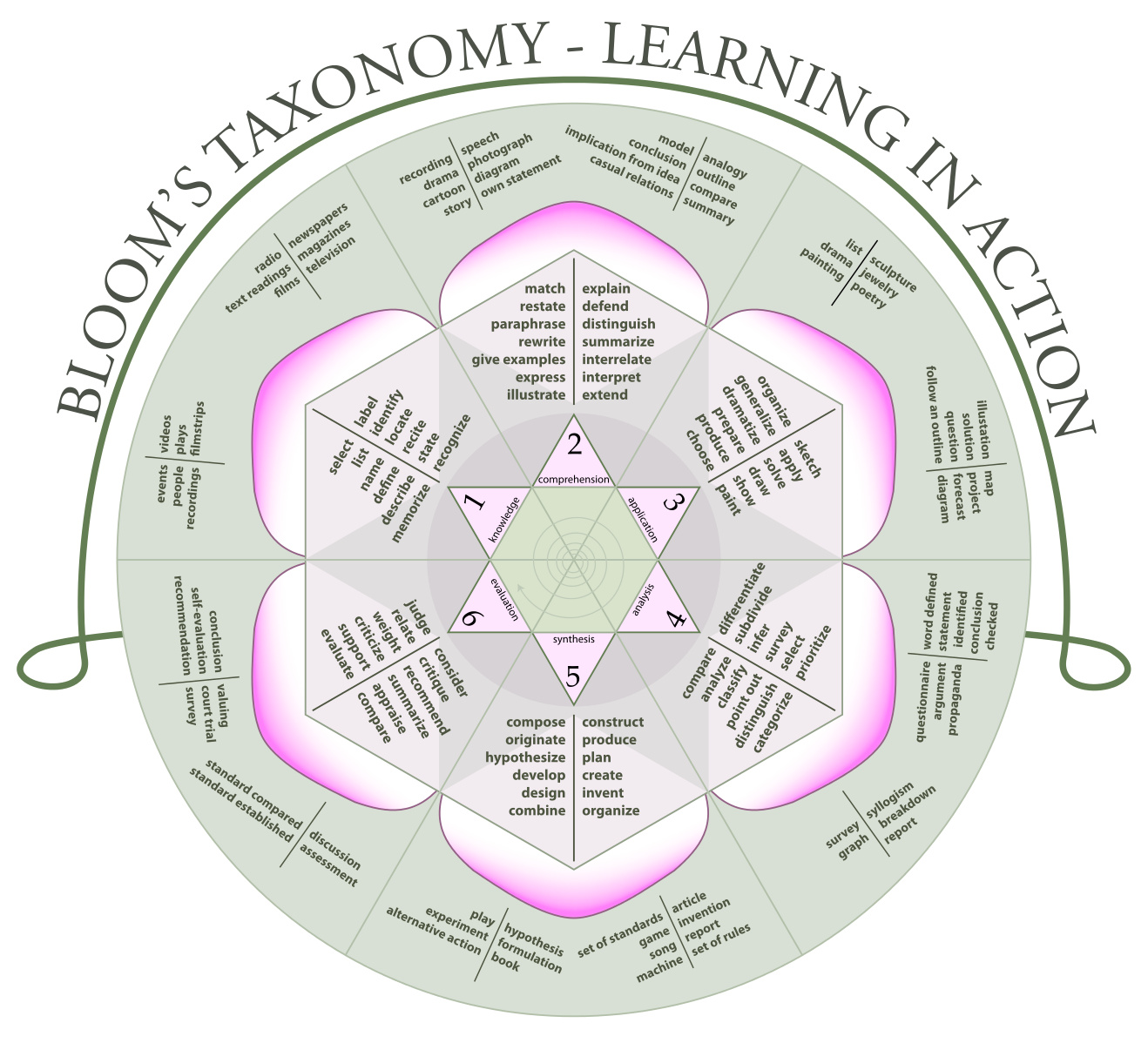
I found this chart used in the field education. The goal was to allow communication between educators on various aspects of students’ learning.

There are six sections in this chart. And many educators agree, that it doesn’t have to be sequential .ie. Application can come before knowledge (in problem-based learning).

Memorizing is only a part of the knowledge section (number 1). This made me understand why focusing on memorization alone, has gotten a bad rap in the education field. Other sections need attention. :relaxed:

5 Likes

So I am a high school teacher about to try to teach this technique, or at least expose my students to it to memorize some lists of things at least initially…

My thoughts were that once you have it memorized, as your understanding of the concept gets better and better, you won’t need the palace anymore.

In reading about these limitations you are all discussing I am wondering if the specific image we attach to loci can be a fluid image that we modify as we learn more about the concept. As we learn more about the concepts, the image can still be outrageous, but the creative process of making it meaningful can lead to more meaningful learning of the material almost to the point where the individual image at the loci and all of its details becomes its own palace?

So we can/will subconsciously visit the loci in the palace when the concept in reference to the other concepts in the palace is important to the problem we are working on, and when a deeper understanding is required we “zoom in” to the image we have been building over time? might even go so far as to include parts of other palaces that we have created for other concepts that we need to solve those problems… as we see that the concept stored in my sock drawer is useful in solving a problem using the concept on my coffee table, I can add a sock to the coffee table, or something from the deeper understanding of the sock drawer concept if my understanding of both have been developed… eventually the familiar foci will dissolve and a network of actual meaning with imagery will be all thats left?

I am VERY new to this so if I learn anything in practice, Ill come back relay it but it is fascinating to think about… I can see how you can spend a lot of time building meaningless palaces that really just help you remember vs putting some more and continued thought into it to make them interconnected…

6 Likes

You are right. You actually don’t need the memory palace anymore once you start to apply the concept in real life and your understanding of the concept gets stronger…

Once I made a Memory Palace to memorize around 50 psychological biases of human mind. I don’t need to refer to the loci anymore to recall the biases. I just know them now or recognize the biases like 'Hindsight bias,Anchoring,Priming effect",etc in me or others. I don’t need the Memory Palace anymore,though I do review those loci of the Memory Palace time to time with spaced repetition system…may be,once in six months…

However,in my work,I have to go through a ordered list almost everyday. The list contains around 61 items to be checked in order everyday. I use a Memory Palace to make sure that I am checking those items in order and not missing any one item!! Though,I could do many of them without using a Memory Palace,I still prefer MP because I think, using a MP is more reliable in this case than just depending on the brain normal ability to recall…Using MP in this case is like using a checklist!

My point is,there are things like “words,terms,ideas” etc in which you don’t need the Memory Palace anymore after you have grasped the concept well…

But then,there are things like “Checklist,Ordered list,Syntax,Equations,Journal” etc that might need Memory Palace!

However,one thing is clear: if you want to grasp the concept of a term forever and get rid of the MP,you have to apply it in real life, in context! Memory Palace itself will not make you a knowledgeable and creative person unless you apply in real life what you have stored in your MP!!!

9 Likes

If I understand your complaint well, the drawbacks you’re experiencing majorly deal with the speed of retrieval for different pieces of info. stored in different palaces. Let me suggest some possible solutions;

 •You can try to improve the encoding of the info., such that the real life concept and the palace representative are LINKED in a way that the concept STIMULATES its representative. I believe this can significantly reduce retrieval time.
 •You could use the same palace for related concepts or groups of concepts(admittedly in medicine, many concepts will be related so this won't be easy).
 •From your post, you're a prolific user of palaces, so I'll also suggest setting aside a specific time(once or thrice weekly, or as convenient), to REVISE your palaces. This will increase the transfer of the memory from short term to long term, and as you practice you may realise that you'll be less reliant on deliberately having to visit your palace to conjure up/access the memory.

Dominic O’Brien wrote in one of his books that the palace serves as a means of holding the info., and that the more you access/revise the info. the less reliant you’ll be on accessing the palace for that particular info.
Thanks, hope this helps.

2 Likes

The REAL issue is that raw, rote memory has been the norm in education in the U.S. and Europe for many centuries and that the “cattle” process of modern day schools, for those who are not rich nor from rich families, only facilitates rote.

Ever sit in on a lecture?
Notice how fast the person is talking?
It’s a result of our modern technologized culture which is about 3G → 4G → 5G → Ad Infinitum G and the Inter & Intranets everywhere and the accompanying stress it has brought.
It’s a culture we created and it’s a culture we can uncreate.

Keep that in memory folks

Stefos

3 Likes

In coherence to memory I’ve realized that linking not only visual cues but also touch, smell and emotions greatly increase both the recall and retention. In fact, memory palaces don’t have to be inactive pieces of data. I like to use Eidetic memory in this case to create a virtual reality that I can use by just closing my eyes and reaching into it either physically or mentally just like plucking an apple off a tree. I like to think of as if I’m wear virtual glasses.

I have found by physically relating rooms to buttons or information to inventories and menus that I can take that next step to making my MP into a more realistic and coherent reality. In sum, I’ve created a system which allows for an almost seamless boarder between physical and mental spaces. I’m currently using this to learn Japanese kanji and their otherwise multi-phonetic possible pronunciations. So I know it functions well with learning languages. Though, this method is still in a trial mode so to say but so far from the data I’ve collected as of now recalling information is easier.

2 Likes

I used to have this problem but I found a solution. I always link a key word in the question to my place and loci. So I don’t have to walk through the entire palace to find an answer. If the question is let’s say, “examples of car brands”, I’ll first create an image for the question which will be a car with eggs :egg: all over it. In my syllabic memory system for words, image of eggs is for the word, “examples”. So I link that image to the answers

1 Like

I solved this problem a little while ago by starting with one memory palace interior, having the first locus always be a portal back to the “origin palace” and have a character to tell me what I’m there for so I can always reuse any palace, and every locus after the first one gets used like normal but it also has a character that represents another memory palace. So I can descend through the palaces quickly because they’re all linked, I always have a way back, and because I organize it from general to specific like a file directory, I can ballpark guesstimate whereabouts the info I need is gonna be if there’s copious quantities of info. I call it the “Dungeon Method” just because it reminds of the way you descend in dungeons in videogames like Dragon Quest IX: Sentinels of the Starry Skies and Fate. But it’s based on @gavino 's thing, he’s who I got the idea from.

2 Likes

But I’m about to read through everyone else’s responses to this post to see if there’s better ideas

The information contained in all your memory palaces for learning should be broken down into chunks -mini mps so that the mind could easily grasp the information in a contextual scenario. It’s like a cause and effect approach. Also like developing muscle memory in martial arts -in real life threats, all your knowledge goes down the drain your mind will be on auto pilot as it subconsciously gathers data to respond to the situation.

2 Likes

There is one solution for this prblm…jst create a search option in u r memory palace …train u r brain to immediately retract the info …for eaxmple if u created a memory palace with 100 loci then try to image…that in the search option u r thing of a particular loci…then u go to it directly

1 Like

55 =

Samuel L Jackson is about to deliver his legendary line when the overhead compartments bump open and suddenly it’s raining rubber snakes!
He swears blue murder as he thinks he’s battling the real thing far beyond anything that makes sense, but the snakes just keep pouring out the overhead lockers
Dramatic movie music in the background rather than Benny Hill

Hey bro I want to ask you something please do reply if you can , I am preperation fir 12 boards and main problem is chemistry reactions they just have 2 words so I had no way other than using 2 words and find new word sso that I can associate with it but I am not able to get words let’s say I need word for OH I can find some but not much because of this I many times stuck and I also use dictionary but I can’t find good words taht i can really associate , so bro I want to know that how I can improve on this , and please also can you tell me how you broden your vocubalaruy taht you can make 1000s of loci pleas bro help me I need help :pray::pray:
Thanks for your time

I’ve found this to be true as well. That’s an okay trade-off for me though. I think my problem is that because it takes way too long to set up when I have a tight deadline. Perhaps that’s a matter of just practicing more though.

What, that memory palace doesn’t help you apply the knowledge? That isn’t a memory palace issue, that’s a very common misconception about what learning is. Knowing something doesn’t really mean learning it. You have to actively use the new information so it forms connections to old information (and other new information) and eventually becomes more than a factoid.

1 Like

Never said it was an issue