With a well-organized palace, you can achieve the best results. In mathematics, I only have the concepts; problem-solving processes are something else entirely, stored in a different kind of memory.
Understanding how learning works will help you focus your efforts on what works. Use the memory palace to memorize concepts, and the structured palace again to organize topics.
An interconnected palace will help you move from one topic to another very quickly, allowing you to answer questions rapidly. You’ll also be able to associate topics quite quickly.
Let’s say you have a palace for mathematics, with about 100 points or loci for each key arithmetic concept, and another for algebra. These are interconnected, creating a massive knowledge network, like a dictionary.
Why use a memory palace for concepts? For the same reasons mentioned, it also takes longer to forget, and if you understand how to use image formation techniques to make them difficult to forget, you’ll be ahead of everyone who doesn’t use them… in other words, you’ll be faster.
The biggest problem is:
Not having the necessary knowledge to make memories last in the mental palaces. If someone were to teach this, you wouldn’t have to be searching everywhere, like I was a while ago.
Having solutions to problems that arise in image formation, since there are several techniques you can use depending on the information, and also the way you want to retrieve that information, such as a tree, table, lists, etc. A table is cross-referenced information; that is, if you have a palace of 100 loci, you can connect everything to everything. This is good when the information is on the same topic.
To say that memory palaces are useless for “critical thinking” is to judge hastily. Not knowing how to use them is one thing; the question is, “How can we use a memory palace to improve critical thinking?” Take a mental image, say from arithmetic, the concept of subtraction, which in a mental image can be translated as a “thief.” Use that simple image to argue about subtraction in many ways. Lawyers could have multiple cross-references as well.
Analytical memory is another source for learning step-by-step processes, as with mathematics. You must break down the process step by step, understanding and linking (AB-BC-CD), like questions and answers. Don’t try to use visual memory as your only resource in this case; here, I only use it to memorize formulas that are important to me.
If schools had teachers who taught the art of learning, students would be better prepared, since memorization is only one part of it.
I believe palaces were more used since appeared memory tournaments. In 20 th century for education the link or peg were easier and more popular in books.
I don’t how to use palace well but are very powerful. It seems it needs less cognitive energy that link or peg. You don’t have to recall it. You know the place very well. And the information it’s attached to it.
The matter about education system is a big lie. Education system was saying 200 years that memory techniques were bad and thinking is better. Its false. Are different things and work together. And the exams depends of memory. Now psychological research says that memory techniques works they can’t lie anymore. But anyway they don’t use either.
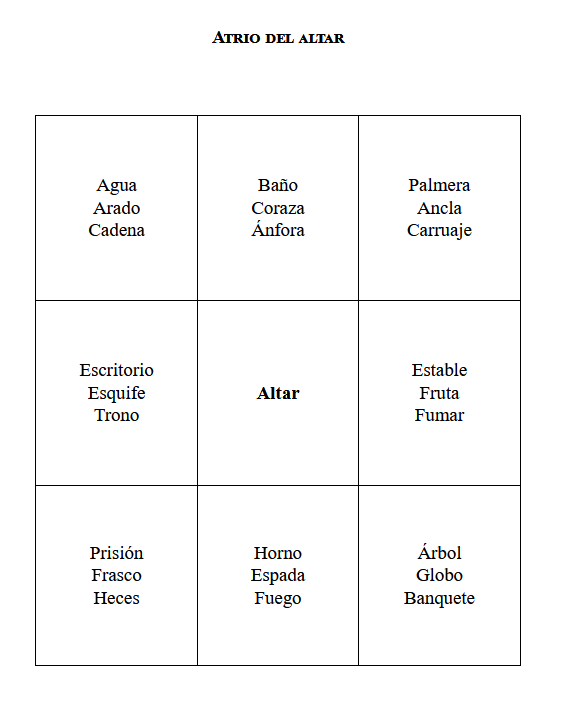
If you need a peg system, here’s a method that works well:
Use familiar places for this system; they should be square or give you the impression of a square.
Use categories from which you’ll draw objects.
Choose a number, like 10, 20, or 30.
Last step: use the association chain and review it about three times, taking breaks between reviews.
Now, in each place, using the “kitchen of horror” category:
Example with one angle: bloody knife, pan with guts, fork with an eye, etc.
There you’ll have a library of fairly clear and emotional pegs. They should be personal; you can use comics and other sources to create this.
When you need to memorize something, remember to always have a clear algorithm, that is, clear steps. For example, I memorize:
I need to memorize a historical figure and their date. The algorithm will be peg → name of the historical figure → date… so the association will follow that sequence. I have examples, but they are in Spanish.
Asociación: Desde una torre cae una guillotina (Guillotina suena a Guillermo) sobre un conquistador (o sobre el dios Zeus).
Palabra de fecha:ZeuS → Z=6, S=6 (66, asumiendo el año 1066).
Creditos: The New Art of Memory (este ejemplo adaptado por mi al español)
Los lugares estan llenos de objetos y personajes en algunos casos, por lo que el lugar esta lleno de clavijas mnemotecnicas que funcionan como loci.
Lambert Schenckel (1610) y el “Gazophylacium”
Repetición de Sentencias: Le dictaban 25 frases latinas inconexas. Él las escribía, las leía dos veces y luego las repetía hacia adelante, hacia atrás y en cualquier orden aleatorio.
Memorización Masiva: Un alumno suyo, tras pocas semanas de entrenamiento, fue capaz de memorizar 300 palabras y oraciones dictadas al azar, repitiendo el ítem número 235 o el 128 instantáneamente al ser interrogado.
Independencia del Idioma: Schenckel demostró que su sistema funcionaba para dictar cartas a 10 o 30 secretarios a la vez en diferentes idiomas, manteniendo el hilo de cada una sin confundirse.
Le recomiendo entrenar el arte, mientras mas entrena el cerebro se va reconfigurando y adaptando, lo dificil es mantenerse, existen demasiado metodos, elija uno y apliquese al menos unos 6 meses… tome digamos memorizar palabras, numeros, etc., vaya paso a paso… subiendo niveles, es decir aumentar velocidad o presionarse (esto funciona muy bien, la presion hace que la adaptacion sea mas rapida), y nada solo es practica, practica y mas practica… puede investigar, cuando encuentra una solucion vuelva a seguir practicando, si en 1 o 2 dias esta estancado vuelva a consultar y a seguir practicando.
Por el tema de los problemas encontrados le sugiero un registro de sus practicas, hagalo y no se arrepentira, asi sabra en que falla, es decir no pude recordar tal palabra, estoy olvidando cada ciertos items, las cadenas fallan, etc., sabra en que enfocarse y no estara reiniciando partida cada vez o aprendiendo a fuerza bruta.
Ah gracias.a mi me gustan las historias. No es tan efectivo pero me las acuerdo mejor y me gustan. Como. Guillermo va a conquistar Inglaterra le ponen un cómico en la torre qué se burla de el. 66 para mi Es jeje.
Me gustó tu idea de hacer palacios temáticos. A mi Me cuestan los palacios comunes y si dicen de hacerlos temáticos. Pero que cada ítem sea temático no lo había visto.
Para que usted note que esto solo se trata de practicar y que se pueden lograr cosas que con la memoria natural es mucho mas dificil, le recomiendo leer a “pietro da ravenna”, un mnemotecnico prolifico que podia recitar leyes por su primera letra y mas hazañas, para que tenga mas ejemplos… elija una tecnica le recomiendo la de ravenna de dividir palabras en silabas o tricilabas para formar palabras visuales como por ejemplo “arlizt = arbol + lista”, existen otros como los alfabetico que solo toma 3 letras de las mas sonoras como “ali” de la palabra engorroza anterior que puede ser “aaron moten sobre un leon en un altar”… muchos sistemas existen, no los tome todos, vaya usando segun requiera.
Estos casos demuestran la capacidad de retener volúmenes enteros de literatura o historia.
Joseph Scaliger (1484):
Se relata que aprendió de memoria toda la Ilíada de Homero (31.670 versos) en solo 21 días.
Posteriormente, memorizó la Odisea completa en un tiempo aún menor. También se dice que dedicó 40 lecturas a los libros de Metafísica de Aristóteles hasta que pudo repetirlos con facilidad.
Justus Lipsius (1547):
Este famoso crítico y filósofo recordaba la historia completa de Tácito de memoria.
La Prueba del Puñal: Tenía tanta confianza que ofrecía recitar cualquier pasaje permitiendo que una persona estuviera a su lado con un puñal, con permiso para apuñalarlo si fallaba en una sola palabra o cometía un error.
El Joven Corso (Relato de Muretus, 1585):
Muretus relata el caso de un joven de Córcega que estudiaba derecho civil en Padua.
La Hazaña: Podía escuchar una lista de palabras latinas inconexas y repetirlas todas en orden exacto, luego al revés, y luego saltando (la primera, la tercera, la quinta, etc.).
Capacidad: Afirmaba poder repetir 36.000 nombres de esta manera.
Enseñanza: Según el relato, enseñó su arte a un patricio veneciano con mala memoria, quien en 7 días logró retener 500 nombres,.
Obispo Jewell (1571):
Podía repetir cualquier cosa que hubiera escrito después de leerla una sola vez.
Prueba de Lord Bacon: Bacon le leyó una lista de palabras “bárbaras” y difíciles; Jewell las repitió todas sin dudar, tanto hacia adelante como hacia atrás.
Practica con pocos loci, la memoria para la automacidad funciona mejor con esa cantidad (de 3 a 10)… realizar 3 repasos o mas con diferentes velocidades hasta llegar a 1 segundo por loci u objeto temático.
Cualquier tecnica en la que quieras ser rápido haz eso… no lo intentes con 100 de una vez.