Extending the Major System for Mathematical Notation

Very interesting.

Very very interesting to read some of the points of view here.

Not sure I agree with all of them or even strongly disagree but maybe the following will give newcomers to memory studies and even newcomers to maths some ideas.

My own interest in the subject is that I use Memory Systems to comprehend the applied mathematics I use (and very often have to create myself) in my work and occasionally (usually because something is bugging me) for pure mathematics for recreation. Learning new maths is like entering a dark mansion and exploring each room, you bump into furniture and trip over things and then eventually you light a candle and see roughly how things are then - usually quite suddenly - you find the light switch and it’s all clear. Then you move to the next room. That’s how the guy who “solved” Fermat’s Last Theorum described how he works. Can’t recall his name..

Anyway my interest for work is primarily using analysis (calculus) with a very heavy emphasis on exponential functions and this cruises over into my memory work - how to develop mental representations of learning and forgetting curves - lots of Sigmoid functions, half and other life calculations and (lots of variations) on logistic functions with partial derivatives.

Like most people who work with mathematics. I work with letters both Greek and abcdefg etc, symbols and operators, ±/°^✓∆÷×|~ dx/dt, e^-kt, π, i, phi, Ω, sigma etc.

The point I’m trying to make is that starting with arithmetic and then basic algebra (up to and including logarithms to different bases) then the two main parts of calculus - every one of these standard functions and their inverses (addition, subtraction, multiplication, division, roots, logarithms, derivatives, integrals, growth, decay,) every one has an operator symbol and usually more than one. And you need to know them. To the point you’re not consciously having to think about them. The symbols represent what you do. + Isn’t the same as ÷.

I encoded the concept by the symbol. Because I understand the concept. The fundamentals.

I don’t personally encode the symbol by the concept. That’s just learning by rote or parrot fashion and with maths the beauty for me comes from the understanding.

So I’d share that for maths I’ve got a whole national park full of experiments and examples encoded by visual scenes where the characters I use build visual representations of stuff that is fundamental.

To visualise steady rate, versus constant acceleration, versus exponential growth and their inverses) I encoded that using imagined drone races (a bit like Robot Wars) where each team (yes I had teams) has to have their drone travel exactly the same distance in the same time - then visually I could compare the differences of the paths.

The use of geometrical representations helps. Well it helped me, especially for visualising

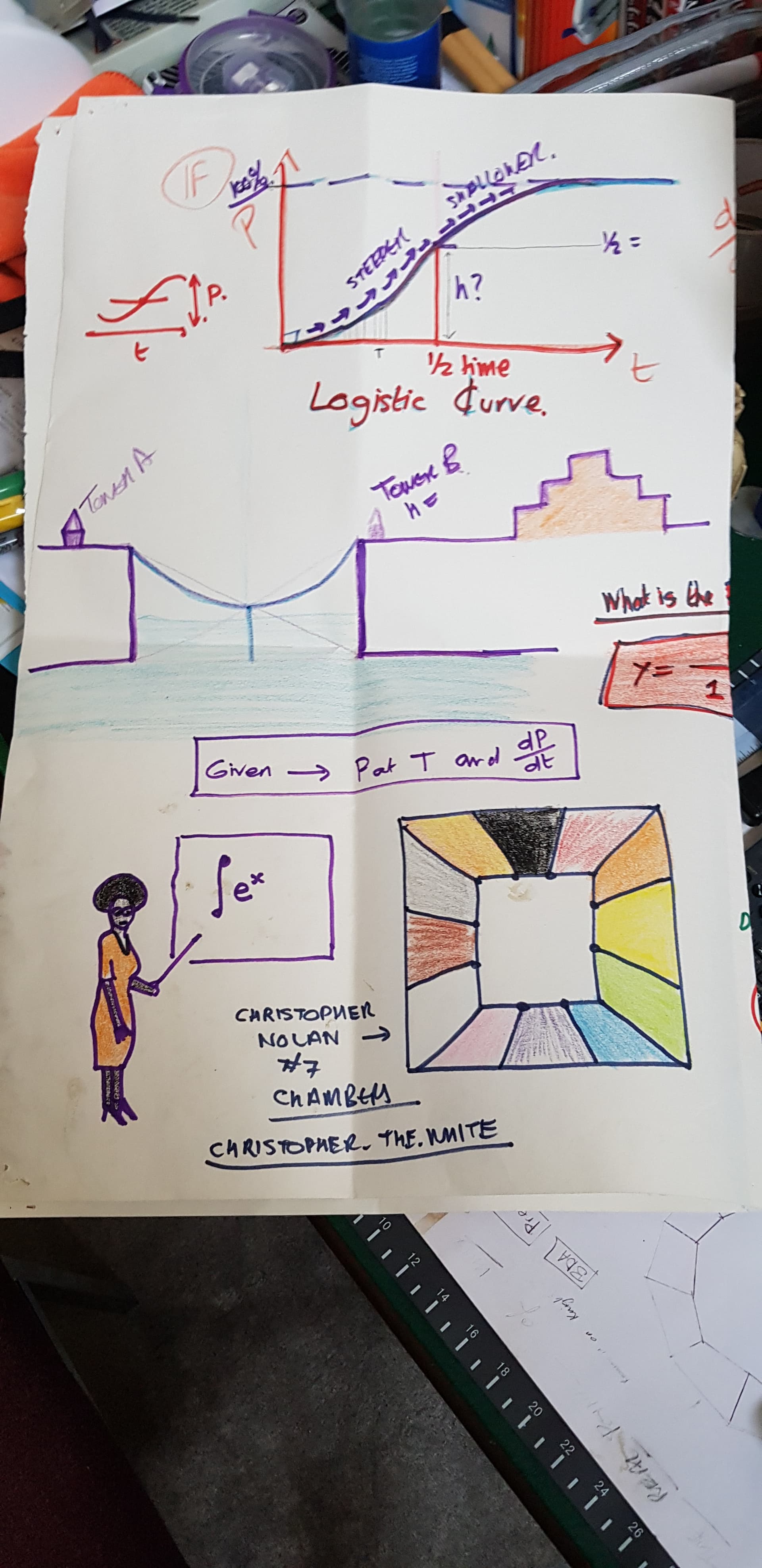
E.g I’ve got Sister Wendy (a nun who used to present TV documentaries about art) getting pushed off a 1km high platform (by Richard Feynman - I’m not aware he had anything against nuns but if he did I wouldn’t mind) he pushes the nun off the 1000m high platform over Loch Lomond, she can slide along a wire. The wire is sometimes straight sometimes curved, where the poor woman screaming her head off accelerates (under G or with a rocket pack striped to get back) towards her target - Newton’s platform which is half way to the water below, the tilt can be varied and Gallileo times it using of numbers, Leibnitz works out her area under her path, Archimedes calculates her distance by infinite series Newton works out the force… Lots of mathematicians all known (to me) to be THE specialist of that little part of the overall impression.

Integrals and partial derivatives can be (I say) visualised by comparison of variables in different runs of the same mind experiment. I’ve got a forest full of experiments…

Here’s one directly to do with memory:

Rate needed to complete a task. Like memorising one hundred numbers. With no system
Change in time needed when you use the peg system.
Change in time when you introduce a journey..
Change observed in results when you introduce the major system.
Change observed when you introduce a PAO… Or a PAOS
Change observed using a different type of memory palace.

These variations are all visualisable in visual mathematical language using symbols and stories and memory palaces but (I argue) that you need to know the meaning of the symbols - what a change in one field will make to the overall result. Plus of course the investment in mental work to develop these systems.

Very useful is Newton’s notation which is used still by physicist where a s with a dot above (or any letter) gives the first derivative and with two dots represents the second derivative. S-dot is the name and s-double dot. The second derivative.

All of which I am really familiar with.

Thing about mathematics is:. Rule 1 - You work ON PAPER.
Rule 2 - DON’T FORGET RULE ONE.

Once you know what you are talking about - encode it into a memory palace. But DON’T THROW AWAY THE PAPER! YOU WILL FORGET.

IN SHORT:

Where memory techniques (for me) come in is AFTER I understand every function or procedure or branch of mathematics I’m using in great detail - only then will I once it’s easy to put onto paper - would I put it into a memory system usually as a story with characters and (if necessary) numbers.

The point that zvuv made in his first post above about the absence of operators - I would STRONGLY recommend from my own experience that know your operators and functions as visualise stories.

The major system is useful. There are other approaches that you might find both simpler and quicker… If you’re trying to get better at maths.
Mm

The pic is supposed to be Katherine Johnson…
3 Likes

As a mathematician (my degree was in Pure Mathematics) I’m just quoting this to say I agree with it. Understanding comes first, otherwise you don’t even have anything useful to remember.

It would be like—to extend the analogy of Andrew Wiles (who solved Fermat’s Last Theorem) as above—trying to remember where all the furniture is in a dark room before you’ve figured out the light switch. Memorizing it once the light is on would be a much simpler task, and may (or often need not) use any specific memory techniques.

#########################

Another point above I found interesting was about visualizations in Pure Mathematics. When I studied it, there were a couple of topics that I just couldn’t understand:

  • Eigenvectors of infinite-dimensional vector spaces
  • Special relativity (okay that’s Applied Mathematics but whatever)
  • C —> C (functions from the complex numbers to themselves)

After graduating, I realized what was holding me back: I didn’t know any way to visualize these things. For abstract algebra, real analysis, number theory, set theory, statistics etc., I could visualize things in my mind. A function that tends to a limit at infinity while its derivative grows unbounded? Easy. Eigenvectors of an infinite-dimensional vector space? No idea.

Right now, I’m helping edit a textbook for primary age Mathematics (pupils 6–7 years old) and the authors made a lot of effort to ensure the pupils will be able to visualize basic things like triangles, and halves. I wish that a similar approach had be used at university-level for more abstract topics.

3 Likes

While I agree with the last two posts, that’s not really what the original poster was asking about. He was asking about memorizing constants with exponents, but also other operators. Assuming you know the reason behind the math, it’s a matter of knowing the actual numbers or equations.

Major system (and Dominic, etc.) is great for numbers. And of course mapping it to cards or whatever. But you wouldn’t use it to memorize a list of US Presidents. Similarly, you wouldn’t use it directly to memorize a mathematical equation even though there are numbers involved.

So coming up with something new is required. I would absolutely put some new images together for the operators, like I mentioned above. For scientific notation, pick one for a positive exponent and one for negative. Like choose an eagle (for e) and a white eagle is a positive exponent and a black eagle is negative. Or choose two different birds like an eagle and a flamingo. But birds mean scientific notation. You know it’s always one digit, then the decimal, then more digits so you don’t really need a decimal in this case. But you might want to have one anyway. Just make it something that you always associate with decimal and you’ll know that it’s not part of your number.

So Avogadro’s number would be cheese nips-eagle-nymph while the mass of an electron would be boat-flamingo-meat.

2 Likes

Thanks very much for the thoughtful reply. I was hopeful someone would agree that when it comes to (learning new) maths and memorisation that my experience that memorising without understanding wasn’t best.

I’m not a “pure mathematician”, building on axioms and exploring new patterns and then constantly proving each step (though Gawd knows it does happen even when something bugs me or I stumble across a problem that appears to dovetail with ideas (not necessarily totally proved - people like me who are asked to model things seldom worry too much about vigorous proofs) ideas I know work or seem to work in the real world.

The book you are helping with for primary school kids sounds fantastic. There’s a lot of good work to be done in that area. I am not sure that it is still available but on this forum I once did a post about Feynman’s quote of Newton’s (geometrical) proof about equal areas being swept out in equal times, it struck me that a kid could get more idea visually about what Newton was on about if the kid knew the formula for the area of a sector of a circle by sector, then compared that area to a right angled triangle with the altitude the same length as the section of the circumference. They work out exactly the same. And if the distance along the circumference and going up the altitude of the triangle is covered at the same “speed” i.e. length of time, the area swept out is the same. Something I hadn’t realised.
Funny thing is, it’s so simple to sketch (I sketched a bendable flag pole) and the answers always agree - and no calculus needed! You’ll probably appreciate that the angular momentum is always equal as well. Thing is this flag pole image (made of UNOBTAINIUM) can be used with any function of curve, not just circles and ellipses. And it’s highly visual. A lot more visual than traditional ways of explaining integral calculus.

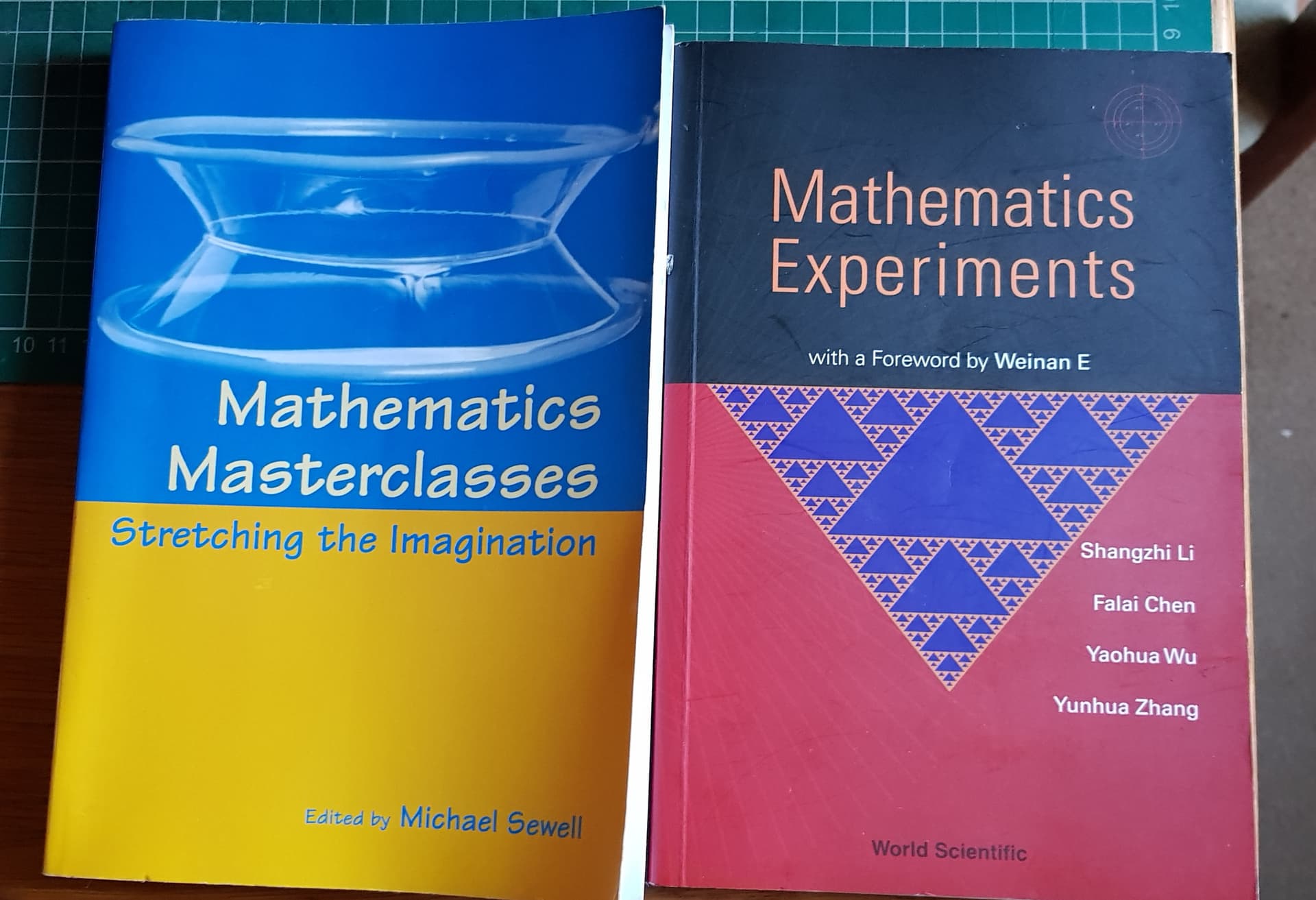
I’ve a number of great books which have sections on visualising maths, couple of them are pictured below. The “Mathematics Experiments” one edited by Weinan has some great things to explore, my head was full of it a couple of years ago. Unfortunately both are extremely expensive…

Thanks again and good luck with your book contribution and your memory studies…

Does anyone know a book where beautifully explained.
How to use mathamatical concepts in daily life. I am not talking about general calculation only like multiplication, division, addition, subtraction…

1 Like

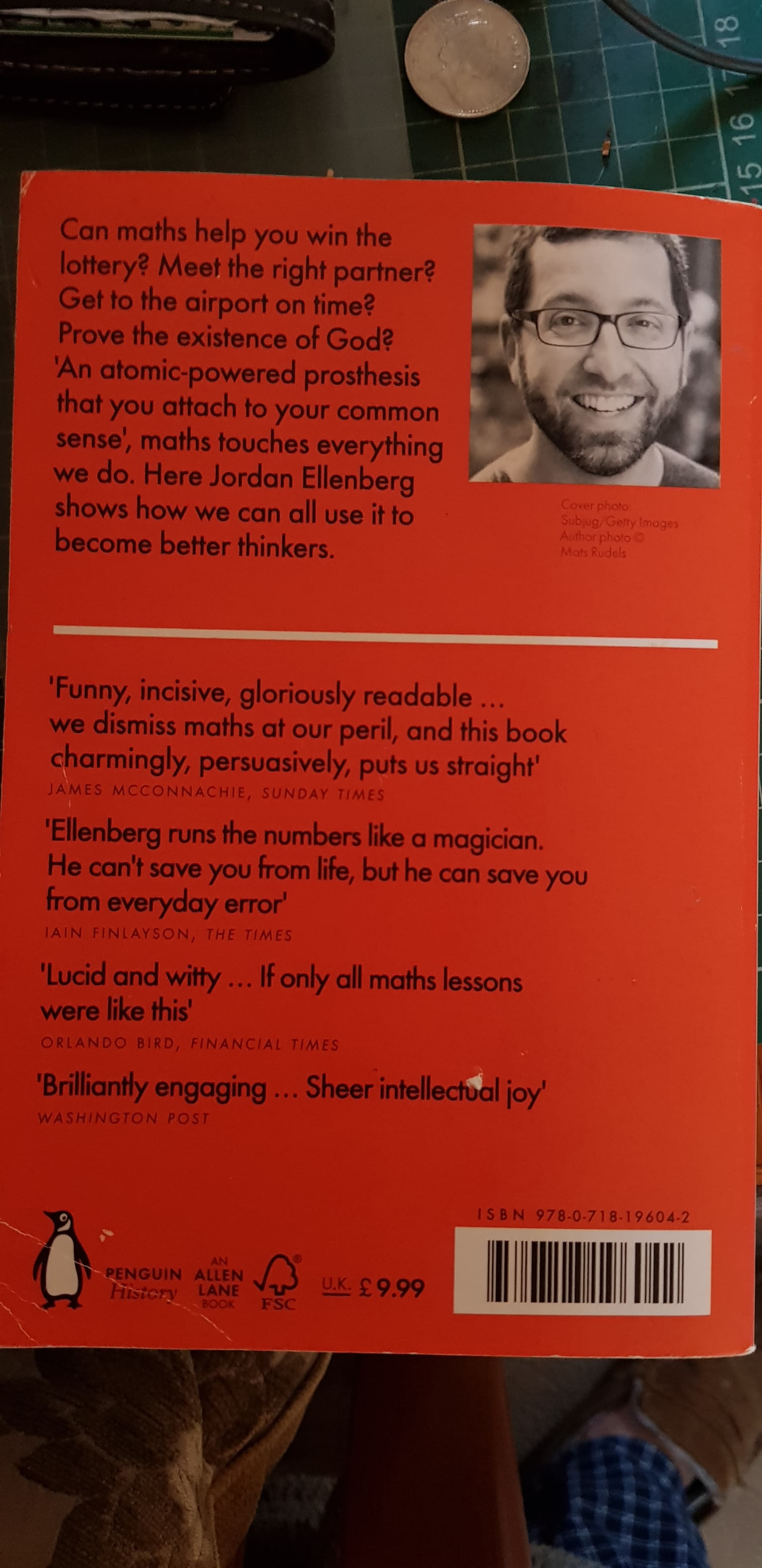
Probably the most famous one recently had got to be Jordan Ellenberg’s How Not To Be Wrong… The hidden maths of everyday life… This guy /author seems to have a knack of finding things that are COMPLETELY UNINTUITIVE that have actually happened in the real world.

It’s not an easy read however, probably better as an audio book.

The other two in the photo are easier to read, and touch upon things that make sense once you can used maths, rather than trying to use "common sense’.

I still find it difficult to believe that statistically IF there are 22 players and one referee on a football field on a Saturday there is a 50% probability that two of those people will share a birthday. Twenty-three people, three hundred and sixty five days… How come?

Lol…

2 Likes

I think I will order that.

I know you asked about the Major system, but I thought it might be worth putting this out there in case some people are interested:

If you use a hexadecimal-phonetic system instead of the major system, you can simply use the extra 6 phonemes to denote special cases that change in different contexts.

0 - s/z
1 - t
2 - n
3 - r
4 - k
5 - f/th
6 - d
7 - L
8 - m
9 - p
(10) - v
(11) - b
(12) - w
(13) - j/dg
(14) - g
(15) - sh

For example:
With playing cards, I can assign a phoneme to J, Q, K.
With dates, I assign a single phoneme to each month.
No special logic required.

In math, you could have up to 6 special characters OR if you need more, you could have modifiers. For example, when I see the phoneme (10), it’s an ‘arithmetic’ modifier and the FOLLOWING digit marks which operator it will be.
(10)0 is a plus
(10)1 is a minus
(10)2 is a multiply
…etc

If you have a clear/logical way to map the special characters that is easy to remember, or if you just practice a little bit, you could potentially have up to 6x16 special characters. (And it could be many more if you have a complete 0-3+(16)(16) three-phoneme system)

To be clear, I have no experience with Math, I haven’t applied this system to math myself. Depending on exactly what you need, you could assign the extra phonemes in any way you like and still use your regular mnemonic images for 3-digit strings of numbers.

1 Like

That was interesting reading your thoughts.
I never tried to develop a general system for mathematical notation since I could always get-back to formulas once well understood (or with some tricks, like limit cases or specific values).
Now, memorizing bare numbers like constants is quite more difficult and I think using mnemonics is quite relevant here. Although I think that orders of magnitudes should be known without mnemenics (a physicist should know that the mass of the electron is in the 10^-31 kg and a chemist should know that Avogadro number is in the 10^23) it is useful to develop a system to remember scientific numbers.

To answer you initial question, here is how I would memorize constants using major system :
I would use scientific notation and encode each constant with a sentence/story featuring a person. Person (common noun) would encode the exponent, if this is a man then this is a positive exponent, if this is a woman then this is a negative exponent. Base number is encoded with the common nouns of the sentence. I do not need to take care about the dot since it always has the same position. This way I can encode numbers with arbitrary accuracy (I just need to make longer stories to get more decimals), with positive and negative exponents and the exponent comes first when retrieving the number (giving me immediately the order of magnitude). I do not see the point of remembering the sign of the base number but system could be refined in order to encode this information as well.
For example :

  • Avogadro number : 6.022 x 10^23
    I would imagine NEMO (+23, it is a boy!) drinking some JUICE (60) with his NANNY (22)
  • Mass of the electron : 9.1094 x 10^-31
    I would imagine my friend MADY (-31, it is a girl!) on a BOAT (91) driving a SUBARU (094)

As mentioned above I think knowing at least the orders of magnitude is quite essential in physics and engineering. Knowing it also helps to map the constant to the story : if you know that Avogadro number is in the 10^23, you know that Avogadro story is the story about Nemo …