First, let’s put the method up for people who don’t know the way he calculated:
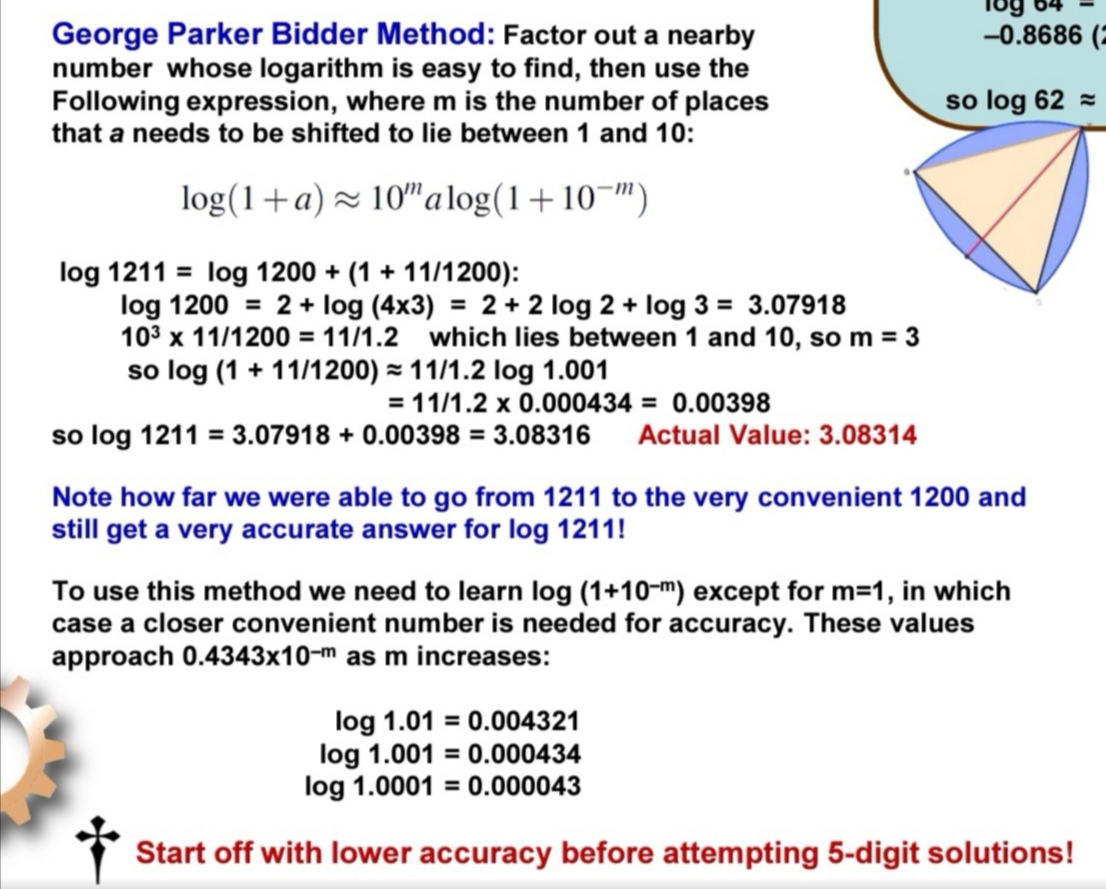
His way is almost exactly the way I calculate logarithms for small differences, for example here: Calculating logarithms by hand - #5 by Kinma
Let’s stay with the example of 1211.
If you want to know the logarithm of 1211, you start with a number close to this of which you either do know the logarithm or you can easily calculate it.
1200 is 100 * 3 * 4, so
log 1200 = log (100 * 4 * 3 ) = log100 + log3 + log4
So now you know log 1200.
What is left is calculating the difference between 1200 and 1211.
Since in logarithms we can add the logs of factors, we need to see the difference between 1200 and 1211 as a factor of 1200.
For me, it is much easier to say we need to find the difference as a percentage.
Same thing; different wording.
If I were to find log1212 - instead of 1211 - then I could just say “add one percent”. Adding one percent is the same as using a factor of 1.01.
And he - just like myself - has memorised log 1.01 as 0.0043.
(It is written he could calculate up to 8 or 9 digits, so he memorised it with more digits, but for the sake of this post I want to keep the numbers short)
So if we were to calculate 1212, we could just add 0.0043 to log1200.
However; we are now calculating 1211 or 11 points over 1200, which is 11/12 of 1%.
This is the factor 1+11/1200 in the example in the explanation of his method.
The method is basically saying: If we need 11/12 of 1%, we can just take 11/12 of 0.00434. 11 / 12 * 0.00434 \approx 0.00398.
I skipped one step; on purpose. Try to understand the method until here.
The method has a complicated looking extra step:
log(1+a) \approx 10^m a log(1+10^{-m})
In the method, you need to choose m such that 10^m * a lies between 1 and 10.
(This is complicated and - imho - not necessary, but for the explanation of the method we keep this up. I’ll explain later a simpler method.)
Choosing m means choosing any of the 0.0043 (m=2), 0.000434 (m=3) or 0.000043 (m=4).
Back to the example to illustrate.
If I choose m to be 3, then 11/1200 * 10^3 is between 1 and 10, namely 11/1.2.
The method then chooses log1.001, instead of log1.01.
This is the 1+10^{-m} part.
1 + 10^{-3} = 1.001
So it chooses 0.000434 (log1.001) and moves the decimal point using 10^m.
(btw, you can see me do this throughout the whole thread of calculating logarithms by hand, so go there for more examples. For simplicities sake I usually use 0.0043).
The method does not explain why we can do this.
Here is why:
For changes less than about +/- 3% one can assume that the graph is lineair (!). It is not, but for practical reasons we can assume it is.
If we know that log1.01 is 0.00432, then log1.02 = 0.00864.
log1.02 is twice as big as log1.01.
Log1.03 is 0.01286 or 0.0043 times 3. Well, actually it is 0.01284 so from +/- 3% this starts to break down.
Log 0.99 is -0.0044
Log 0.98 is -0.0088 (or 44 * 2)
Log 0.97 is -0.0132 (or 44 * 3)
This is true for small changes between +3% and -3%.
And the smaller the change the better we can assume linearity!
Here are even smaller changes. Let’s see what happens is we divide 1% by 10 and repeat this:
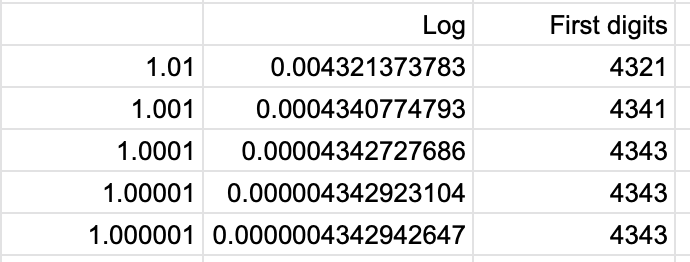
If we forget the decimal point, and just focus on the digits, we see ‘43’, or ‘4343’ turn up. I can explain 4343 in a different post, but just remember this number for now. Tip: log(e).
Also 2.3 will turn up. This is 1/log(e) or ln(10).
Depending on whether you will be multiplying of dividing either use 4343 or 23.
Reread the pdf and things will hopefully be easier to digest now.
If not, feel free to ask.
Now the simpler method.
If you only remember 4343, you know now that log(1.001) = 0.0004343.
Going back to 1211. What is the smallest number for which we know the logarithm?
We started with 1200 = 100 * 4 * 3. However, 1210 is 11 * 11 * 10 and this number is easy to calculate the log for (and much closer to 1211).
Instead of 11/1200 we now get a difference of 1/1210, so about 11 times more accurate!
BTW. See here to calculate log 11: Calculating logarithms by hand - #5 by Kinma without using a calculator.
From 1210 the difference - as a factor - with 1211 is only (1+ 1/1210)
This is roughly 0.8 per 1000. So use 80% of log(1.001) = 0.8 * 0.00434 = 0.003472.
1/121 \approx 0.08 is very rough.
We can do a more accurate calculation of 1/121 = 0.0826. If we multiply this by 0.004343 we get 0.0035873… Tip; do 826 * 43 and add 1%.
0.0035873 is very close to the actual log(1+1/1210) = 0.0035877
So we add 0.0035873 to log1210 and we are done!